Kinetic Molecular Theory Worksheet
A free kinetic molecular theory worksheet with answers covering the five assumptions the model rests on and the everyday gas behaviour each one explains.
This kinetic molecular theory worksheet with answers gives 24 questions on the model behind every gas law, with full explanations in the printable PDF.
What the model actually claims
Kinetic molecular theory is a short list of assumptions about what gas particles are doing. Particles move constantly and randomly. They occupy almost none of the container. Their collisions lose no energy. They neither attract nor repel one another. And their average kinetic energy depends only on the absolute temperature.
None of those is exactly true of a real gas, which is the point worth holding on to. They are close enough at ordinary temperatures and pressures that the gas laws work, and they fail in predictable ways when a gas is squeezed hard or cooled towards its boiling point.
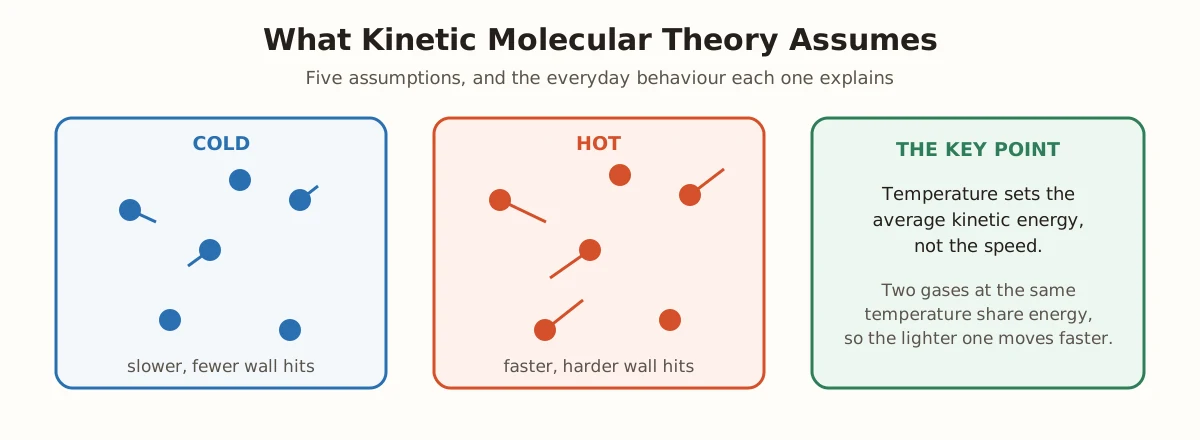
The last assumption is the one students most often misread. Temperature fixes the average kinetic energy, not the average speed. Because kinetic energy depends on both mass and speed, two gases at the same temperature have the same energy but different speeds, and the lighter one is moving faster.
What this kinetic molecular theory worksheet with answers covers
Part A asks what each assumption buys you. An assumption that explains nothing is not worth making, so being able to name the behaviour it accounts for is the test of whether it has been understood rather than memorised.
Part B works from the other end, giving an everyday observation and asking for the particle-level reason. Part C changes one variable at a time and asks what happens and why, which is the gas laws rebuilt from the model rather than recalled as formulas.
Part D applies Graham's law. Because lighter particles move faster at the same temperature, the rate of diffusion goes as the inverse square root of the molar mass, and the sheet asks both which gas wins and by what factor.
How to answer an explanation question
Give two steps, not one. Say what happens to the particles, then say what that does to the measurement. "The balloon shrinks because it is cold" scores nothing; "lower temperature means less kinetic energy, so the particles strike the wall less often and less hard, and the balloon contracts until the pressures match" is a complete answer.
Watch for questions where the volume is fixed. If a container is rigid, all the extra energy from heating goes into wall collisions, so pressure rises sharply. If the container can expand, the gas grows instead and the pressure barely changes. Which of those applies is usually the whole question.
The formal definition sits in the IUPAC Gold Book. For the quantitative side, the gas laws worksheet drills how a fixed sample responds to changing conditions and the ideal gas law worksheet covers PV = nRT.
Try a few before you print
Type the formula of the faster gas, or the factor to three significant figures.
Questions students ask
Do all gases at the same temperature move at the same speed? No. They have the same average kinetic energy. Lighter particles reach that energy at a higher speed.
Why are collisions called elastic? Because no kinetic energy is lost. If they were not, a sealed gas would gradually slow down and its pressure would fall on its own, which does not happen.
When does the model break down? At high pressure, where particle volume stops being negligible, and at low temperature, where attractions between particles start to matter.
Is an answer key included? Yes. The final pages give a model answer for every explanation question and the full working for Graham's law.