Dimensional Analysis
This dimensional analysis worksheet gives Grade 9 to Grade 11 students 26 marks of practice on the factor-label method.
This dimensional analysis worksheet gives Grade 9 to Grade 11 students 26 marks of practice on the factor-label method — the one conversion technique that tells you when you have set it up wrong.
What the dimensional analysis worksheet covers
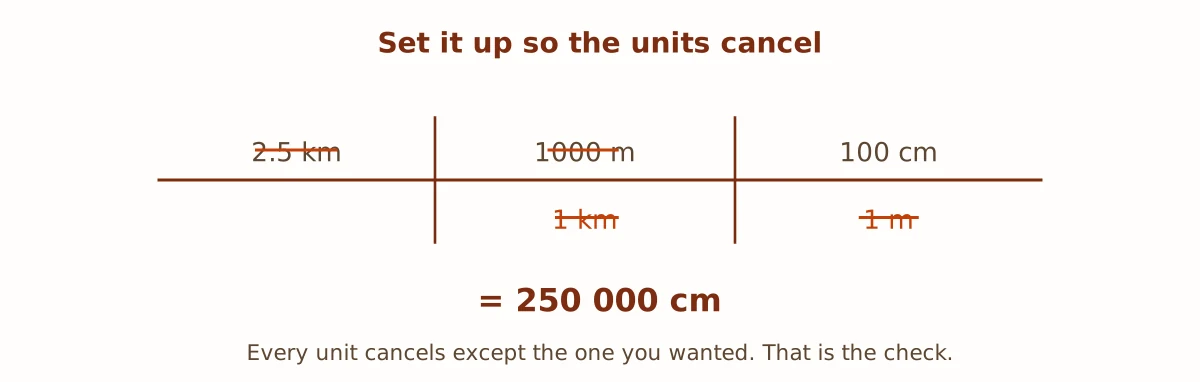
Dimensional analysis, also called the factor-label method, converts units by multiplying by fractions that equal one. Since 1000 m and 1 km are the same length, the fraction 1000 m / 1 km equals one, and multiplying by it changes the units without changing the quantity at all. That is the entire justification, and it is worth stating once because students often treat the method as a ritual.
The real payoff is that the method checks itself. Each fraction is arranged so the unit being removed sits on the opposite line from where it already is, and the pairs are crossed out. If the units left over are the ones that were wanted, the set-up is right and arithmetic is the only remaining risk.
Why it beats doing it by instinct
For a single step, instinct works. Converting kilometres to metres, most students multiply by 1000 without writing anything down and get it right. The method earns its keep when the problem has two or three steps or compound units.
Converting 72 km/h into m/s by instinct means guessing whether 3600 goes on the top or the bottom, and roughly half of students guess wrong. Set up as fractions, hours sit on the bottom of the original quantity, so to cancel them the hours must appear on top of a factor — and there is only one way to write it that works. The method converts a guess into a decision the paper makes for you.
Compound units
Part B includes a density conversion from g/cm³ to kg/m³, which is the problem that separates students who understand the method from students who have memorised a sequence. Two factors are needed and they pull in opposite directions: dividing by 1000 for grams to kilograms, multiplying by a million for cubic centimetres to cubic metres. The net factor is 1000, which almost nobody predicts correctly without writing it out.
Fuel consumption in litres per 100 km appears too, because it is a rate students meet outside school and it makes the cancelling concrete.
Diagnosing a wrong set-up
Part C gives two incorrect set-ups and asks what went wrong. In the first, a factor is upside down, so the leftover units come out as km²/m rather than metres. That nonsense unit is the signal, and learning to read it is the skill: a student who checks their leftover units will never submit a conversion that is off by a factor of a million.
The second has the time factor inverted in a km/h to m/s conversion. Both errors are the ones that actually appear in marked work, and fixing someone else's is a faster route to not making them than being warned.
How to use this worksheet
The sheet prints on standard letter paper and runs about forty minutes, with a worked chain shown at the top so students have the layout in front of them. It is the right preparation for stoichiometry, where every problem is a chain of conversion factors and the units are the only thing keeping a student oriented.
For the background, our guide to unit conversions covers the underlying facts. Our significant figures calculator handles the rounding these answers need, and the rest of our science worksheets carry on into chemistry calculations. NIST publishes the defined conversion factors.
Practise dimensional analysis online
Answer these five questions and check them instantly. They use the same method as the printable sheet.
- Convert 72 km/h to m/s.
- Convert 2.50 L to cubic centimetres.
- How many seconds are in one day?
- To convert km to m, the conversion factor has km on the top or the bottom?
- Convert 90 km/h to m/s.