Counting Significant Figures
This counting significant figures worksheet gives Grade 9 and Grade 10 students 26 marks of practice on deciding which digits in a measurement carry information.
This counting significant figures worksheet gives Grade 9 and Grade 10 students 26 marks of practice on the one question that decides every answer: which digits in this number were actually measured?
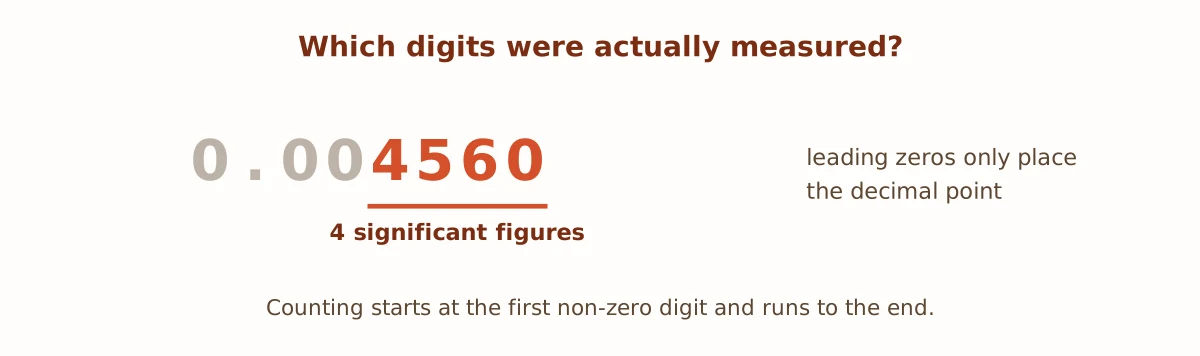
What the counting significant figures worksheet covers
A measurement is only as good as the instrument that produced it. Significant figures are the digits that were actually determined by measuring, as opposed to the digits that only show where the decimal point sits. A balance reading 4.56 g has three significant figures because a person could read three digits off the display.
The same mass written as 0.00456 kg still has three. The zeros at the front are not measurements; they are there because the unit changed. Students who hold on to that idea can reconstruct every rule on the sheet, and students who only memorise the rules tend to lose them by the following term.
The six rules, and the one that is not a rule
Five of the six are clean. Non-zero digits always count. A zero between non-zero digits counts, so 4005 has four. A leading zero never counts, so 0.0045 has two. A trailing zero after a decimal point counts, so 4.500 has four. Counted and defined values have unlimited significant figures.
The sixth is different, and Part C is built around it. A trailing zero in a whole number with no decimal point is genuinely ambiguous: 1200 could have been measured to the nearest hundred, ten or unit, and the notation gives no way to tell. This is a real gap in the notation rather than something students have failed to learn, and textbooks resolve it differently. Scientific notation removes the doubt completely, which is a large part of why scientists use it.
What is on the sheet
Part A gives sixteen numbers to count, chosen so that every rule is exercised at least twice and several numbers test two rules at once. Part B is the harder half: six numbers where students have to say what each zero is actually doing rather than produce a total. A student who can explain 2.0070 can handle anything.
Part C takes two ambiguous whole numbers and asks for the smallest and largest number of figures each could carry, written properly in scientific notation. That converts a confusing edge case into a skill.
Where students lose marks
Three mistakes account for most of them. The first is counting leading zeros, which turns 0.0045 into four figures instead of two. The second is dropping trailing zeros from an answer, writing 4.5 where the measurement justified 4.50 and throwing away a digit that was earned. The third is treating the exponent in scientific notation as though it carried precision, so 6.022 × 10²³ gets counted as twenty-six figures rather than four.
All three come from the same place: treating the rules as arbitrary instead of asking whether a digit could have come off an instrument. Part B is written to force that question, because a student who can say what each zero is doing will not make any of the three.
How to use this worksheet
The sheet prints on standard letter paper and runs about twenty-five minutes, which makes it a good opener for a measurement unit or a review before a lab. The rules are printed on the sheet itself so it works without a textbook to hand.
To check answers quickly, or to try numbers that are not on the sheet, our significant figures calculator marks each digit as significant or not and flags the ambiguous cases rather than guessing. Once counting is secure, the next step is applying the rules to calculations, which our science worksheets cover. The NIST pages on SI units are a reliable reference for how measurements should be written down.
Practise counting significant figures online
Answer these five questions and check them instantly. They use the same rules as the printable sheet.
- How many significant figures does 4005 have?
- How many significant figures does 0.0045 have?
- How many significant figures does 4.500 have?
- How many significant figures does 100.10 have?
- Read as placeholders, how many significant figures does 8000 have?