Classifying Matter Worksheet
A free classifying matter worksheet with answers covering the two questions that sort any sample into an element, a compound, a homogeneous mixture or a heterogeneous one.
This classifying matter worksheet with answers gives 28 questions on sorting samples, telling physical change from chemical, and choosing a separation method, with the reasoning spelled out for every answer in the printable PDF.
Two questions sort everything
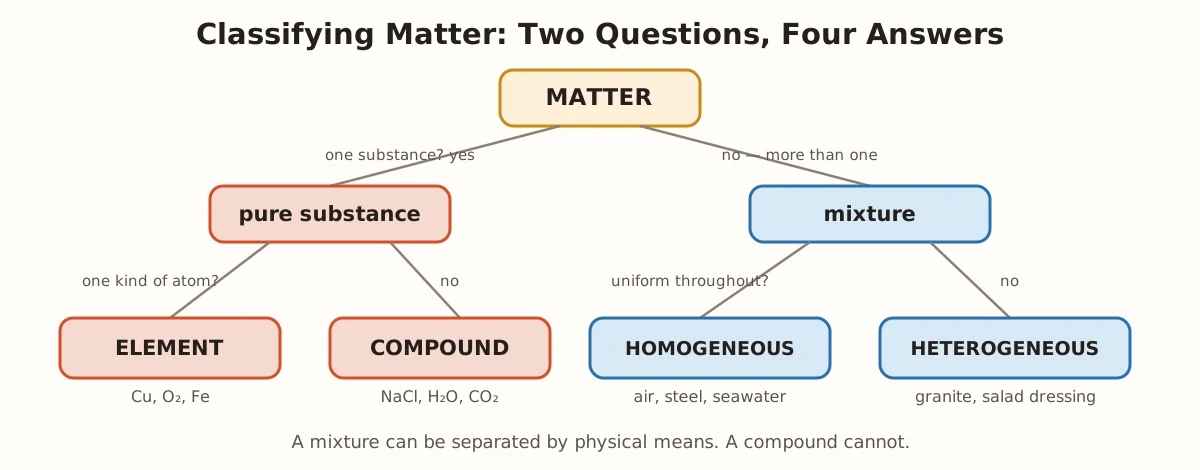
Classification looks like a list of four categories to memorise. It is really two yes-or-no questions asked in order, and getting the order right is most of the skill.
First: is this one substance, or more than one? One substance is pure. More than one is a mixture. That single question splits the whole of matter in two, and nothing else can be decided until it is answered.
Then the follow-up depends on which way you went. For a pure substance, ask whether it is built from one kind of atom. If so it is an element; if not, it is a compound. For a mixture, ask whether it looks the same everywhere. If so it is homogeneous, which is what a solution is; if not, it is heterogeneous.
Asking the second question first is the usual mistake. "Is it uniform?" has no useful answer for a pure substance, because a pure substance is uniform by definition. The question only discriminates once you already know you have a mixture.
What this classifying matter worksheet with answers covers
Part A gives twelve samples and asks for the classification and the reason. The reason carries the mark, because naming the category correctly by recognition proves nothing about whether the tree has been understood.
Part B contrasts physical and chemical change across ten examples. Part C asks which separation method suits each mixture and which physical property it exploits, which is where the earlier classification pays off.
Physical or chemical?
The test is whether a new substance exists afterwards. Melting, dissolving, boiling and reshaping all leave the same substance behind in a different form, so they are physical. Burning, rusting, souring and fizzing produce something that was not there before.
Reversibility is a useful clue but not the rule. Dissolved salt comes back when the water evaporates, which fits. But some chemical changes can also be reversed by another reaction, so lean on whether new substances formed rather than on whether you can undo it.
The formal definitions are in the IUPAC Gold Book. Once compounds are classified, the naming ionic compounds worksheet covers writing their names and formulas, and the types of chemical reactions worksheet sorts the chemical changes into their five families.
Try a few before you print
Type element, compound, homogeneous or heterogeneous — or physical or chemical.
Questions students ask
Is a solution a mixture or a pure substance? A mixture. It looks uniform, which makes it homogeneous, but it still contains more than one substance and can be separated physically.
How is a compound different from a mixture? A compound has a fixed composition and its parts are chemically bonded, so only a chemical reaction separates them. A mixture can be separated by physical means.
Is dissolving a chemical change? No. The dissolved substance is unchanged and comes back when the solvent is removed.
Is an answer key included? Yes. The final pages give the classification, the branch of the tree that produced it, and the evidence for every change.