Alkenes and Alkynes Worksheet
A free alkenes and alkynes worksheet with answers covering IUPAC naming of unsaturated hydrocarbons, the general formulas that separate the three families, and the structural reasons a double bond behaves as it does.
This alkenes and alkynes worksheet with answers gives 22 questions on naming unsaturated hydrocarbons and on why a double bond changes how a molecule behaves, with a full key in the printable PDF.
Saturated and unsaturated
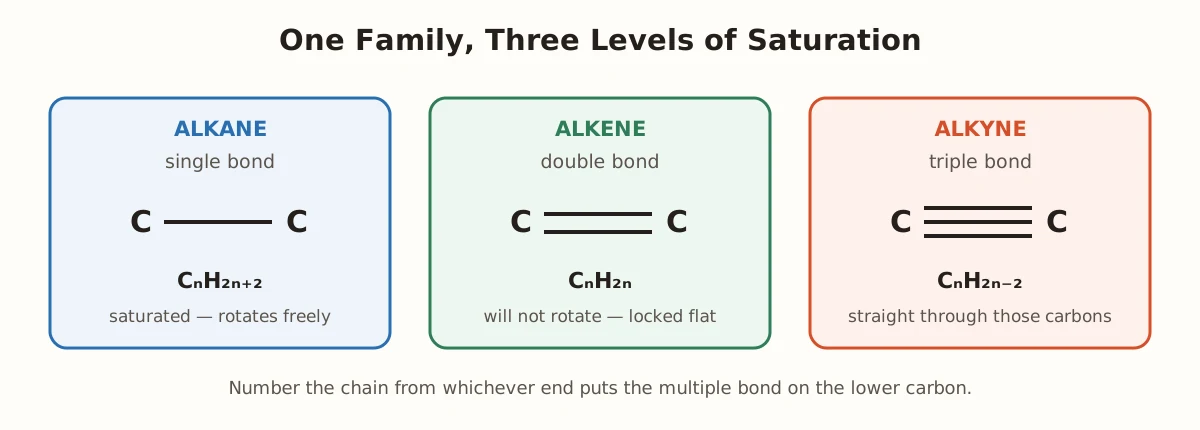
An alkane carries as many hydrogens as its carbon skeleton can hold, which is what saturated means. Replace a single bond between two carbons with a double bond and two hydrogens have to go, giving the alkene formula. Make it a triple bond and two more go, giving the alkyne formula.
That is the whole of the general-formula pattern, and it is worth deriving rather than memorising. Counting hydrogens against the number of carbons tells you immediately which family a formula belongs to, with no structure needed.
The multiple bond also changes the shape. A single bond lets the two ends rotate past each other freely. A double bond cannot rotate, because doing so would break the sideways overlap that forms the second bond, so the atoms around it are locked into one plane.
What this alkenes and alkynes worksheet with answers covers
Part A gives a chain length and a bond position and asks for the IUPAC name and the molecular formula. Part B gives bare formulas and asks which family each belongs to. Part C asks for explanations: why double bonds will not rotate, why bromine water tells alkenes apart from alkanes, and why there is no such thing as methyne.
Telling them apart in the lab
The general formula sorts the families on paper, but a simple test sorts them on the bench. Bromine water is orange. Shake it with an alkane and it stays orange, because an alkane has no multiple bond to react with and substitution needs ultraviolet light to get going.
Shake it with an alkene or an alkyne and the colour disappears within seconds. The bromine adds straight across the multiple bond at room temperature, with no catalyst and no light, which is the practical consequence of being unsaturated.
Numbering the chain
Number from whichever end gives the multiple bond the lower locant. A six-carbon chain with a double bond between the fourth and fifth carbons counted one way is between the second and third counted the other, and the lower number wins, so it is hex-2-ene rather than hex-4-ene.
Write the number only where more than one position is possible. Ethene has two carbons and one bond between them, so no number is needed. Propene has three carbons and the double bond can only sit at one end, because numbering from the far end would give the same molecule.
The formal definitions are in the IUPAC Gold Book. The naming alkanes worksheet covers the saturated chains these build on, and the naming covalent compounds worksheet covers the prefix system used for simple molecular compounds.
Try a few before you print
Type the IUPAC name or the family.
Questions students ask
Why is there no methene or methyne? A double or triple bond has to sit between two carbons. One carbon has no partner to share it with.
When do I need a position number? Whenever more than one position would give a different molecule. That starts at four carbons for alkenes.
How does bromine water tell them apart? An alkene or alkyne adds bromine across the multiple bond and the orange colour disappears. An alkane leaves it coloured.
Is an answer key included? Yes. The final pages give the name, the molecular formula and a model explanation for every question.