Adding and Subtracting with Significant Figures
This adding and subtracting significant figures worksheet gives Grade 10 and Grade 11 students 26 marks of practice on the rule that sums and differences are governed by decimal places rather than significant figures.
This adding and subtracting significant figures worksheet gives Grade 10 and Grade 11 students 26 marks of practice on the decimal-place rule, which is not the rule that governs multiplication.
What the adding and subtracting significant figures worksheet covers
Addition and subtraction do not use significant figures at all. They use decimal places, and the answer is rounded to the fewest decimal places of any number going in. This is the single most confused point in the topic, because the multiplication rule is usually taught first and students carry it across.
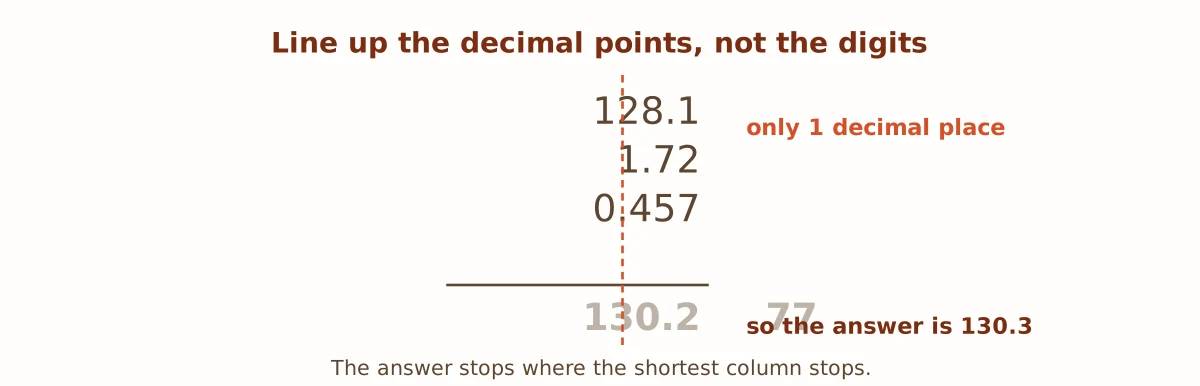
The reason becomes obvious when the numbers are written in a column with their decimal points lined up. If one measurement stops at the first decimal place, nothing at all is known about the second decimal place of the total, no matter how many digits the other measurements carry. The answer has to stop where the shortest column stops. Part A's working column asks which value set the limit, which is where a student reveals whether they counted places or figures.
The result that looks like a mistake
Subtracting two close numbers destroys significant figures. A beaker massing 100.0 g before and 99.8 g after gives a loss of 0.2 g — four figures in, one figure out. Students assume they have done something wrong. They have not. The two readings agree in their first three digits, those digits cancel, and nothing can recover them.
This has a practical consequence worth stating in class: it is why laboratory methods avoid measuring a small difference between two large readings, and why a mass loss is measured directly whenever the apparatus allows it. The arithmetic rule and the lab technique are the same fact seen from two sides.
Whole numbers and the coarsest place
The rule extends past the decimal point. If 1250 is only good to the tens, then 1250 + 3.7 is still 1250, because the 3.7 falls entirely inside the uncertainty of the first number. Part A includes this case, and it is a useful corrective for students who believe adding something always changes the answer.
Mixed calculations
Part B combines both rules. In 12.13 + 1.72 × 3.4 the multiplication is done first and is limited to two significant figures, which places its last reliable digit at the first decimal place; the addition is then governed by decimal places and the answer is 18.0. The key shows the unrounded intermediate at each stage, because carrying the full value and rounding once at the end is the habit being taught.
Where marks get lost
The dominant error is counting significant figures on a sum. Asked for 128.1 + 1.72, a student reasons that one input has four figures and the other three, so the answer gets three, and writes 130. The correct answer is 129.8. Part C asks for that mistake to be explained in words, because a student who can name it stops making it.
How to use this worksheet
The sheet prints on standard letter paper and runs about thirty minutes. Giving it in the same lesson as the multiplying and dividing sheet is the fastest way to stop the two rules blurring together, since the contrast is the lesson.
To check an answer, our significant figures calculator names the governing rule at each step and says when a subtraction has cost figures rather than leaving it looking like an error. The rest of our science worksheets cover measurement and the chemistry calculations these rules feed into, and NIST documents how measured values should be reported.
Practise adding and subtracting online
Answer these five questions and check them instantly. They use the same rule as the printable sheet.
- 128.1 + 1.72 + 0.457, to the correct precision
- 2.5 - 0.896, to the correct precision
- 100.0 - 99.8, to the correct precision
- How many significant figures does 100.0 - 99.8 leave?
- 12.13 + 1.72 x 3.4, to the correct precision