Unit Conversion Word Problems
This unit conversion word problems worksheet gives Grade 5 to Grade 7 students 26 marks of practice on problems where the measurements arrive in different units.
This unit conversion word problems worksheet gives Grade 5 to Grade 7 students 26 marks of practice on the problems where the measurements arrive in different units and the conversion has to come first.
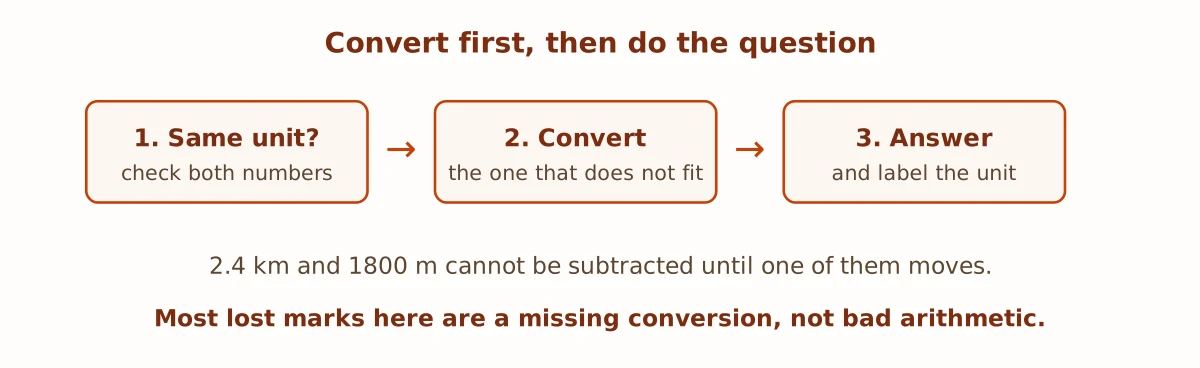
What the unit conversion word problems worksheet covers
Almost every mark lost on a conversion word problem is lost the same way. The student does the arithmetic the question appears to ask for and never notices that the two measurements are in different units. The arithmetic is usually fine; the first step is missing.
2.4 km minus 1800 m is not 0.6 of anything. The numbers cannot be subtracted until one of them moves. The habit this sheet is built to create is checking the units before choosing an operation, which takes a few seconds and prevents the error entirely.
Two steps, every time
All eight problems need a conversion and then something else: a division, a subtraction, or a multiplication followed by a conversion back. A fence 12 m long with posts every 150 cm. A 1.5 L bottle with two drinks taken out in millilitres. A box of tins where the box's own mass has to come off before dividing.
That structure is deliberate. A problem where the conversion is the whole question tests arithmetic; a problem where the conversion is step one tests whether a student noticed it was needed, which is the thing that actually fails in tests.
Remainders that mean something
Three of the problems produce remainders, and the remainder has to be reported in the right unit. A 3 m ribbon cut into 40 cm pieces gives seven pieces with 20 cm wasted, not 7.5 pieces. Students who hand back a decimal have stopped thinking about ribbon and started thinking about division.
One problem divides exactly, which is worth including so students do not learn that every question of this shape has something left over.
Diagnosing the error instead of making it
Part C gives two pieces of wrong work. The first subtracts 1800 from 2.4 without converting, and the giveaway is printed in the answer itself: 0.6 with no unit attached. The second multiplies when it should divide, turning a 175 mm pencil into something 17 metres long.
Both checks are available to any student who looks: does the answer have a unit, and is it a sensible size for the thing being measured? Those two questions catch nearly every error on this topic, and asking students to apply them to someone else's work is a faster route to the habit than telling them to be careful.
How to use this worksheet
The sheet prints on standard letter paper and runs about thirty minutes. It assumes the conversions themselves are already secure, so it works best after the metric length and mass sheets rather than alongside them.
Marking the working is more useful than marking the answers here, since the point of the sheet is whether the conversion step appeared at all. For the background, our guide to unit conversions covers the facts these problems rely on, and the rest of our math worksheets cover metric and customary conversions separately. The NIST pages define the units.
Practise conversion word problems online
Answer these five questions and check them instantly. They use the same ideas as the printable sheet.
- A 12 m fence has posts every 150 cm. How many gaps?
- A 1.5 L bottle less 350 mL and 400 mL leaves how many mL?
- A 3 m ribbon cut into 40 cm pieces gives how many whole pieces?
- Four laps of a 400 m track is how many kilometres?
- A 2 L jug filled with a 250 mL cup takes how many cupfuls?