Metric and Standard Conversions
This metric to standard conversion worksheet gives Grade 6 to Grade 8 students 26 marks of practice converting between the two systems.
This metric to standard conversion worksheet gives Grade 6 to Grade 8 students 26 marks of practice converting between the two systems, and on the fact that only one of the factors is exact.
What the metric to standard conversion worksheet covers
Converting inside the metric system is moving a decimal point. Converting inside the customary system means knowing twelve, sixteen and 5280. Converting between the two is different again, because the factors are untidy decimals that nobody can shift a point to produce.
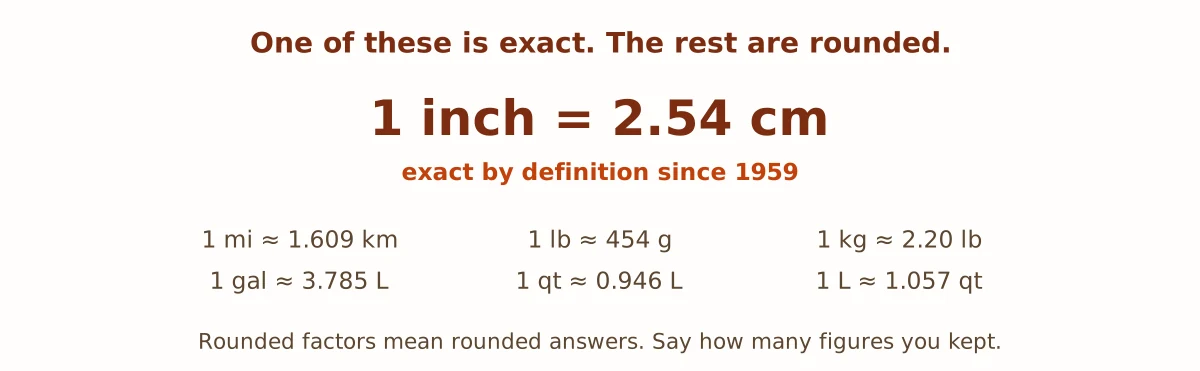
One of them is not untidy at all. 1 inch = 2.54 cm exactly, and has been by international definition since 1959. It is not a measurement and carries no uncertainty, which is why 10 inches is exactly 25.4 cm and can be written with an equals sign.
Rounded factors give rounded answers
Everything else on this sheet is approximate. A mile is about 1.609 km, a pound is about 454 g, a litre is about 1.057 quarts. Answers built on those factors are approximate too, and writing ≈ instead of = says so honestly.
Part C asks students to explain this distinction directly. It is a small point of notation with a real idea underneath: an answer cannot be more exact than the number it was calculated from, which is the same principle that governs significant figures.
Estimating is the skill that lasts
Most people will never multiply by 1.609 outside a classroom, but a great many will need to know roughly how far a 5 km race is or roughly what 70 kg is in pounds. Part B is built for that: four estimates where a rough answer earns full marks.
The benchmarks worth carrying are short. A kilogram is about two pounds. A litre is a little more than a quart. A kilometre is roughly six tenths of a mile, so a 5 km run is a bit over three miles. A metre is a long stride. A student holding those five can sanity check any conversion they do later, and will notice at once when an answer is out by a factor of ten.
Direction, again
The direction rule has not changed from the earlier sheets. There are more centimetres than inches in a given length, so inches to centimetres multiplies. Part A mixes the directions so each question is a decision rather than a repetition, and the estimates in Part B give students a way to check the decision was right.
How much precision is enough
The second written question compares a recipe with a laboratory. A cook converting 500 g of flour to ounces can happily say "about a pound and two ounces"; a chemist cannot round the same way in a titration. How precise an answer needs to be depends on what it is for, and that is a judgement worth making explicit rather than leaving students to guess at it.
How to use this worksheet
The sheet prints on standard letter paper and runs about thirty minutes, and works best after both the metric and customary sheets, since it assumes both systems are already familiar.
Our guide to unit conversions has the full cross-system charts. The rest of our math worksheets cover each system on its own, and the NIST tables give the official factors and say which are exact.
Practise metric and standard conversions online
Answer these five questions and check them instantly. They use the same factors as the printable sheet.
- How many centimetres are in 1 inch?
- Convert 10 inches to centimetres.
- About how many pounds is 1 kilogram?
- About how many kilometres is 5 miles?
- About how many miles is a 5 km race?