Metric Conversions: Moving the Decimal Point
This metric conversion worksheet teaches Grade 5 and Grade 6 students the ladder method: count the steps between two units and move the decimal point that many places.
This metric conversion worksheet teaches the ladder method: count the steps between two units and move the decimal point that many places. It works for every metric unit, including ones students have not met yet.
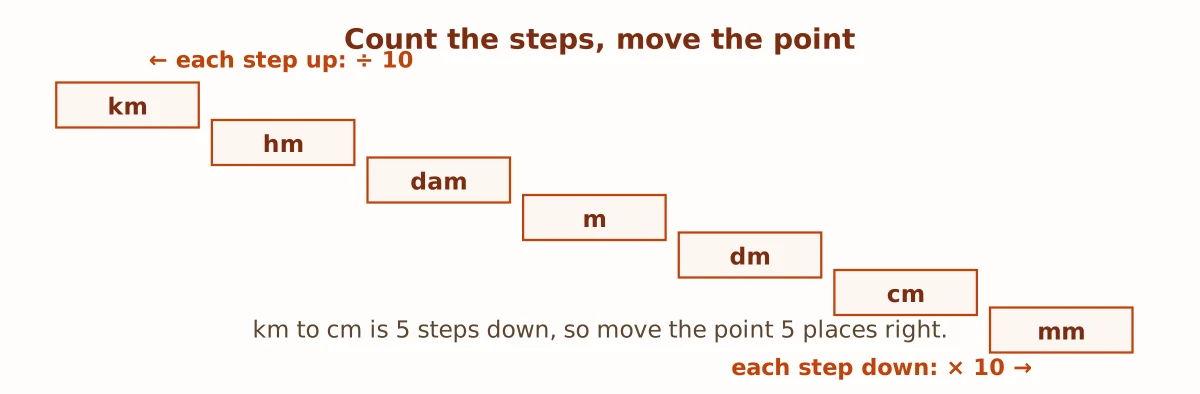
What the metric conversion worksheet covers
Most students learn metric conversions as a list of separate facts to memorise. There is a faster way, and it has the advantage of working for every metric unit ever invented rather than only the ones on the list.
Write the prefixes in order — km, hm, dam, m, dm, cm, mm — and every neighbour differs by a factor of ten. To convert, count how many steps apart the two units are and move the decimal point that many places. Down the ladder, move right. Up the ladder, move left. That is the whole method, and it replaces a dozen memorised conversions with one picture.
Why it works for grams and litres too
The prefixes mean the same thing whatever base unit they are attached to. Kilo- means a thousand and centi- means a hundredth whether the unit is a metre, a gram or a litre, so the distance between any two prefixes is identical in every case. One ladder covers length, mass and capacity.
Part D asks students to explain this in their own words, because it is the idea that makes the method transferable. A student who understands it can convert kilolitres to millilitres having never seen either unit before.
Direction before arithmetic
Part A separates the two decisions that a conversion actually involves: how many steps, and which way. Students fill in both for six pairs before doing any converting. Splitting it out matters, because almost every wrong answer in this topic comes from the direction rather than the count, and a student who commits to a direction first tends to notice when the result is the wrong size.
Part B then applies it to eight values spread across length, mass and capacity, so the single ladder is used on all three in one sitting.
Finding the mistake instead of making it
Part C gives four wrong conversions and asks what went wrong in each. One moves the point two places instead of three. One moves it the wrong way, turning 250 mL into 25 L. One makes a number smaller when it should get bigger. One moves four places instead of three.
These are the four errors students actually produce, and diagnosing someone else's version of a mistake is a reliable way to stop making it. It also tells a teacher something a page of correct answers does not: whether the student understands the method or has been lucky with the direction.
How to use this worksheet
The sheet prints on standard letter paper and runs about thirty minutes. The ladder is printed at the top, so students can refer to it while working and will have a picture to recall in a test. It suits Grade 5 and Grade 6 and works as revision for older students who were taught conversions as memorised facts and never saw the structure.
For the background, our guide to unit conversions explains the prefixes and the most-asked conversions in detail. The rest of our math worksheets cover length, mass and capacity separately and move on to customary units. The NIST prefix table lists every prefix from quecto to quetta, which is worth showing students who ask how far the ladder goes.
Practise the metric ladder online
Answer these five questions and check them instantly. They use the same method as the printable sheet.
- How many steps apart are km and m on the metric ladder?
- Convert 4.2 km to metres.
- Convert 65 cm to metres.
- Converting cm to km, how many places does the point move?
- Convert 0.75 L to millilitres.