Temperature Conversions
This temperature conversion worksheet gives Grade 7 to Grade 9 students 26 marks of practice converting between Celsius, Fahrenheit and kelvin.
This temperature conversion worksheet gives Grade 7 to Grade 9 students 26 marks of practice on Celsius, Fahrenheit and kelvin — the one conversion that shifts the zero as well as the scale.
What the temperature conversion worksheet covers
Every other conversion a student meets is a scaling. A kilometre is a thousand metres, so you multiply by a thousand and you are finished. Temperature is the exception, and that is worth saying before any formula appears, because it explains why the formulas look stranger than the others.
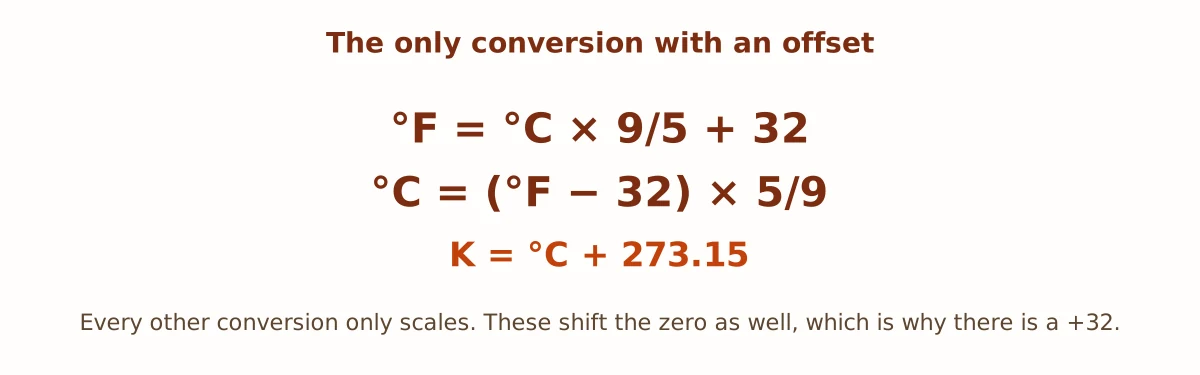
Celsius and Fahrenheit do not agree on where zero is. Celsius puts zero at the freezing point of water; Fahrenheit puts it thirty-two degrees lower. So converting needs a stretch and a shift: °F = °C × 9/5 + 32, and °C = (°F − 32) × 5/9 going back.
Order of operations decides the answer
The commonest error on this topic is doing the two steps in the wrong order. A student converting 20°C who adds 32 first and then multiplies by 9/5 gets 93.6°F instead of 68°F, because the scaling has been applied to the offset as well.
Part D asks students to diagnose exactly that. The landmark check catches it instantly once students have the landmarks: 20°C is comfortable room temperature, and 93.6°F is a hot summer day. Any answer that disagrees with a known temperature is wrong, whatever the arithmetic says.
Why kelvin is the easy one
A kelvin is exactly the same size as a Celsius degree. Only the zero point differs, so the conversion is K = °C + 273.15 with no multiplication at all. Students often assume kelvin must be harder because it looks more scientific, and seeing that it is the simplest of the three is a useful correction.
Two conventions go with it: kelvin takes no degree sign, and it never goes negative, because its zero is the coldest temperature that can exist. Both appear in Part C.
The landmarks worth memorising
Five temperatures do most of the work: water freezes at 0°C = 32°F, water boils at 100°C = 212°F, room temperature is about 20°C = 68°F, body temperature is 37°C = 98.6°F, and the two scales cross at −40°.
That last one surprises students every time, and it is the one they remember. It is also a genuine check: a conversion that puts −40°C anywhere other than −40°F has gone wrong. The dual-scale diagram on the worksheet shows all five on one thermometer so the relationship is visible rather than listed.
Where marks get lost
Three errors account for most of them. Reversing the order of operations, as above. Using 9/5 when converting Fahrenheit to Celsius instead of 5/9, which makes cold weather come out hotter than boiling water. And writing a degree sign on a kelvin value, which costs a mark on most science marking schemes even when the number is right.
All three are caught by the same habit: look at the answer and ask whether that temperature makes sense for the situation described. Students who build that reflex stop needing to remember which fraction goes where, because a wrong choice produces an obviously absurd number.
How to use this worksheet
The sheet prints on standard letter paper and runs about thirty minutes. The formulas and the diagram are both on it, so it works for independent practice. It suits Grade 7 upward and is useful revision in Grade 9 science, where kelvin arrives properly for the first time with the gas laws.
For the background, our guide to unit conversions covers temperature alongside the other measures. The rest of our math worksheets cover metric and customary conversions, and the science worksheets pick kelvin up again in chemistry. NIST defines the kelvin and the Celsius scale built on it.
Practise temperature conversions online
Answer these five questions and check them instantly. They use the same formulas as the printable sheet.
- Convert 100 degrees C to Fahrenheit.
- Convert 68 degrees F to Celsius.
- Convert 25 degrees C to kelvin.
- At what temperature do the Celsius and Fahrenheit scales read the same?
- Convert 37 degrees C to Fahrenheit.