Metric Mass and Capacity
This metric mass and capacity worksheet gives Grade 4 and Grade 5 students 26 marks of practice converting between milligrams, grams and kilograms and between millilitres and litres.
This metric mass and capacity worksheet gives Grade 4 and Grade 5 students 26 marks of practice on grams, kilograms, millilitres and litres — and on choosing a unit that makes sense for what is being measured.
What the metric mass and capacity worksheet covers
Mass and capacity work exactly like length and use the same prefixes, which is the single most useful thing a student can realise about the metric system. Kilo- always means a thousand and milli- always means one thousandth, whatever unit follows.
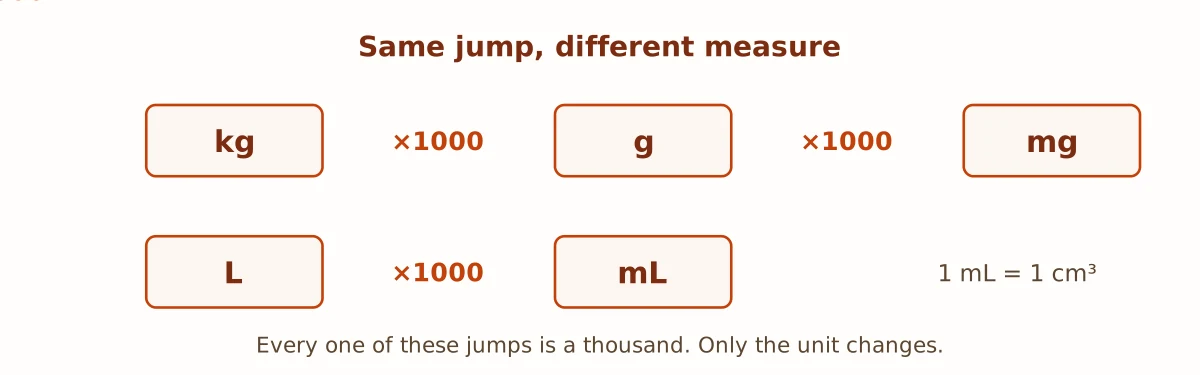
So there are really only two facts on this sheet: 1 kg = 1000 g and 1 L = 1000 mL, with 1 g = 1000 mg following the same pattern. A student who understands the prefix does not have to memorise three separate conversions, and will be able to handle kilolitres or milligrams the first time they meet them.
The fact that links mass and capacity
One extra relationship is worth teaching because it connects the two halves of the sheet: 1 mL = 1 cm³ exactly. A litre of water fills a cube ten centimetres on each side, and a millilitre of water has a mass of one gram. That is not a coincidence — the metric system was designed so the units would line up that way, and seeing it makes the whole system feel deliberate rather than arbitrary.
Choosing a sensible unit
Part B is not a conversion exercise at all. Students match six everyday objects to sensible measurements: a bag of apples, a paperclip, a can of soup, a dose of medicine, a bath and a grain of salt. Getting these right needs a feel for how big the units actually are, which is a different skill from arithmetic and one that catches errors later.
A student with that feel notices immediately when a conversion has gone the wrong way, because an answer saying a paperclip weighs two kilograms is obviously wrong without checking the working. That self-correction is worth more than another ten conversions.
Word problems that need two steps
Part C deliberately uses problems where the conversion is not the whole question. A recipe needing 250 mL from a 2 L carton requires a conversion and then a division. Six books at 450 g each requires a multiplication and then a conversion. The jug and glass problem produces a remainder, and the remainder has to be reported in the right unit.
These are the problems students meet in tests, and they fail them more often from forgetting to convert than from any arithmetic error. Asking for working makes it visible which of the two went wrong.
Where marks get lost
Two errors dominate. The first is going the wrong way, turning 750 mL into 750 000 L instead of 0.75 L, which the sense-check in Part B is designed to prevent. The second is dropping the unit from the answer: a bare 2.7 is not a mass, and on most marking schemes it does not earn the mark. Both are habits rather than gaps in understanding, which means they respond quickly to being named.
How to use this worksheet
The sheet prints on standard letter paper and runs about twenty-five minutes. The conversion facts are printed on it, so it works for independent practice or homework, and the answer key shows the working for every word problem rather than just the answer.
For the background, our guide to unit conversions explains the metric prefixes and answers the most common questions about millilitres and litres. The rest of our math worksheets cover length, customary units and conversion word problems. The NIST pages define the units themselves.
Practise mass and capacity conversions online
Answer these five questions and check them instantly. They use the same facts as the printable sheet.
- How many grams are in 3 kg?
- How many millilitres are in 5 L?
- 2000 g is how many kilograms?
- How many milligrams are in 1 gram?
- 750 mL is how many litres?