Metric Length Conversions
This metric length conversion worksheet gives Grade 4 and Grade 5 students 26 marks of practice converting between millimetres, centimetres, metres and kilometres.
This metric length conversion worksheet gives Grade 4 and Grade 5 students 26 marks of practice converting between millimetres, centimetres, metres and kilometres, including the comparisons that have to be converted before they can be answered.
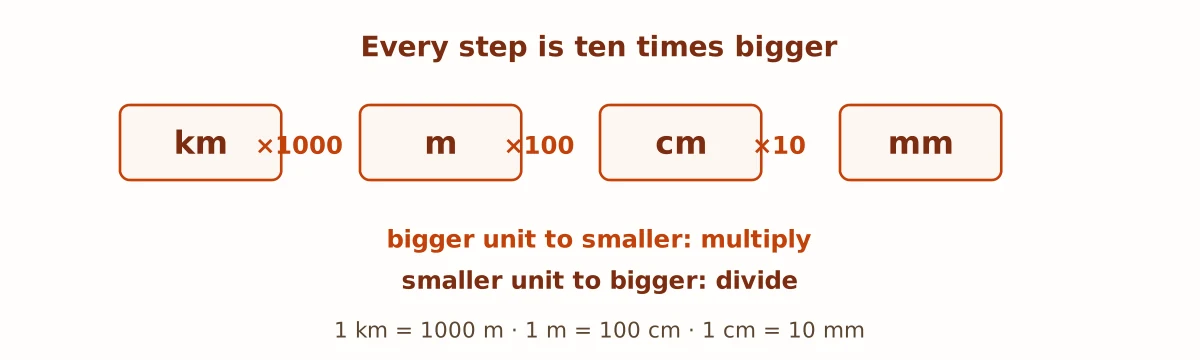
What the metric length conversion worksheet covers
In the metric system every step between units is a jump of ten, a hundred or a thousand, which means converting is never really arithmetic. It is moving a decimal point. That is the whole advantage of the system, and it is why metric conversions are taught before customary ones.
There are only three facts a student needs for length: 1 km = 1000 m, 1 m = 100 cm and 1 cm = 10 mm. Everything on this sheet is built from those three, so a student who knows them can reason out any conversion rather than memorising a table.
Which way to go
The part worth thinking about is direction, and it is where nearly every mistake happens. Going to a smaller unit you need more of them, so the number gets bigger and you multiply. Going to a bigger unit you need fewer, so the number gets smaller and you divide.
The self-check is the useful habit here: if an answer comes out the wrong size, the direction was wrong. Three metres turning into 0.03 centimetres is obviously wrong to anyone who pictures a metre stick, and a student who checks the size of the answer catches the error without being told. Part A mixes the directions deliberately so students cannot settle into multiplying everything.
Comparisons force a conversion
Part B gives six pairs to compare with <, > or =, such as 3 m against 250 cm and 40 mm against 4 cm. These cannot be answered by looking at the numbers, because 40 is larger than 4 while the two lengths are equal. Students have to convert to a common unit first, which is exactly the skill a word problem demands later.
Two of the six pairs are equal, which catches students who assume a comparison question always has a winner.
Word problems
Part C puts the skill in context: a hallway in metres given in centimetres, a pencil in millimetres, a race where one distance is in kilometres and the other in metres, and a ribbon cut into fixed lengths. The third and fourth are the important ones, because both require converting before any other operation can happen. A student who subtracts 1800 from 2.4 has not understood what the question is asking.
Working is asked for throughout. On a conversion sheet the answer alone does not show whether a student multiplied for a reason or because multiplying is what they usually do.
How to use this worksheet
The sheet prints on standard letter paper and runs about twenty-five minutes. The three conversion facts are printed on it, so it works as independent practice without a textbook to hand, and the answer key explains the reasoning for every word problem.
For the background, our guide to unit conversions explains the metric prefixes and why the system works in powers of ten. The rest of our math worksheets cover mass, capacity and customary units. The NIST pages are the authority on how metric units are defined and written.
Practise metric length conversions online
Answer these five questions and check them instantly. They use the same facts as the printable sheet.
- How many metres are in 5 km?
- How many centimetres are in 4 m?
- 300 cm is how many metres?
- 70 mm is how many centimetres?
- How many millimetres are in 1 cm?