Converting Square and Cubic Units
This converting square and cubic units worksheet gives Grade 8 to Grade 10 students 26 marks of practice on the conversion factor that has to be squared or cubed.
This converting square and cubic units worksheet covers the single most common error in unit conversion: dividing an area by 100 when it should be 10 000. 26 marks for Grade 8 to Grade 10.
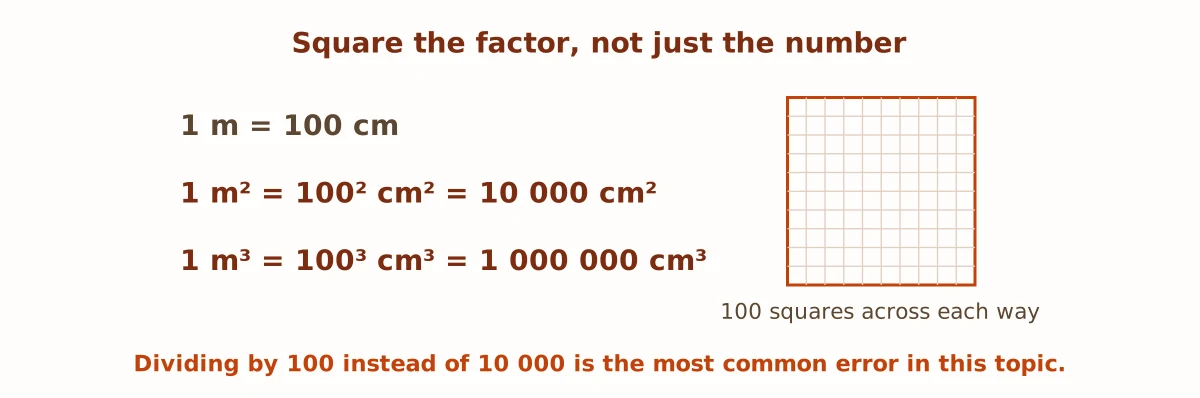
What the converting square and cubic units worksheet covers
Converting 1 m to 100 cm is straightforward, and almost every student can do it. Converting 1 m² to cm² catches almost everyone, because the instinct is to use 100 again. The correct factor is 10 000, and a student who uses 100 is wrong by a factor of a hundred.
The reason becomes obvious the moment it is drawn. A square metre is a square one hundred centimetres on each side, so it holds a hundred rows of a hundred centimetre squares. The factor is squared because the unit is squared. For volume it is cubed, so 1 m³ is 1 000 000 cm³ rather than 1000.
One rule, stated once
The exponent on the unit is the exponent on the factor. That sentence covers every case on the sheet, including mm² to cm², where the factor is 10² = 100, and m² to km², where it is 1000² = 1 000 000.
Part A asks only for the factors, with no arithmetic attached, because the factor is where the error lives. A student who can fill in all six has essentially finished the topic; one who gets the plain-length rows right and the squared rows wrong has shown precisely what needs reteaching.
Checking the answer a different way
Part C gives two worked errors and asks for a way to check each one. The first is a room measured as 600 cm by 400 cm, converted to 2400 m² instead of 24 m². The check is to convert first and multiply second: 6 m × 4 m = 24 m². Two routes to the same quantity should agree, and when they do not, one of them is wrong in a findable way.
The second is a 1.5 m³ tank called 1500 cm³. The check uses capacity: 1.5 m³ is 1500 litres and a litre is 1000 cm³, giving 1 500 000 cm³. Teaching students to verify through a second route is more durable than teaching them to be careful.
Where it connects to volume and capacity
The sheet includes the relationships 1 mL = 1 cm³ and 1 L = 1000 cm³, which tie the cubic units to the capacity units students already know. These are the conversions that make a chemistry or physics problem solvable, and they are exact by definition rather than approximations.
Students who have met the factor-label method will notice that it handles all of this automatically: write the length factor twice for an area and three times for a volume, and the exponent takes care of itself.
How to use this worksheet
The sheet prints on standard letter paper and runs about thirty minutes, with the square-metre diagram at the top for reference. It suits Grade 8 upward and is worth giving to older students too, because this error survives into senior courses and shows up in density and concentration problems.
For the background, our guide to unit conversions covers the metric system and the underlying facts. The science worksheets carry this into dimensional analysis and chemistry calculations, where squared and cubed units appear constantly. NIST defines the units and the derived units built from them.
Practise square and cubic unit conversions online
Answer these five questions and check them instantly. They use the same rule as the printable sheet.
- How many square centimetres are in 1 square metre?
- How many cubic centimetres are in 1 cubic metre?
- Convert 3 m2 to cm2.
- To convert cm2 to m2 you divide by what?
- How many cubic centimetres are in 1 litre?