Plant and Animal Cells: What Is Actually Different
Almost everything inside a plant cell is also inside an animal cell. The differences come down to four structures, and each one exists for a reason you can state in a sentence. Learn the reasons and the list stops needing memorising.
Side by side

Both are eukaryotic cells — they keep their DNA inside a nucleus. The structures labelled in green on the left are the ones an animal cell does not have. Set out this way, plant and animal cells look far more alike than most textbook treatments suggest.
What both cells have
Start here, because it is most of the list. Every structure below does a job that any eukaryotic cell has to do — one with its DNA enclosed in a nucleus and its organelles wrapped in membranes — so both cells carry it.
- Nucleus. Holds the DNA and controls what the cell makes.
- Cell membrane. Decides what enters and leaves.
- Cytoplasm. The jelly everything else sits in, where many reactions happen.
- Mitochondria. Release energy from glucose by respiration.
- Ribosomes. Build proteins from the instructions the nucleus sends out.
- Endoplasmic reticulum and Golgi apparatus. Fold, finish and ship those proteins.
- Lysosomes. Break down waste and worn-out parts.
The cell structure and function worksheet works through these one at a time. The article on DNA to protein follows the nucleus-to-ribosome path in detail, which is the part students most often know by name without knowing the sequence. The cell transport quiz covers what the membrane actually does, since “controls what enters and leaves” hides a good deal of machinery.
Three structures only plant cells have
Cell wall
A rigid layer of cellulose outside the membrane. It is not an alternative to the membrane — plant cells have both, and the membrane still does the deciding. The wall simply holds shape and resists pressure from inside. It is why celery snaps rather than squashes, and why plants can stand up without a skeleton.
Chloroplasts
Green discs packed with chlorophyll, where light energy is captured and used to build glucose. They are the reason leaves are green and the reason plants do not have to eat. The photosynthesis article covers what happens inside them, and the photosynthesis worksheet gives practice on the equation.
One large central vacuole
A single water-filled sac that can take up most of the cell’s volume. Full, it pushes outward against the cell wall and the tissue stays firm; empty, the cell goes slack and the plant wilts. Animal cells do have vacuoles, but small and several, never one dominating bag.
The connection worth drawing out. The wall and the vacuole work as a pair. Water pressure from the vacuole pushing against a wall that will not stretch is what makes a soft leaf rigid. Neither does it alone — which is why a wilted plant recovers within hours of watering, with no repair needed.
What animal cells have that plant cells do not
The list is short: centrioles, small paired cylinders that help organise the spindle when the cell divides. Plant cells divide perfectly well without them, using a different mechanism.
Animal cells are also far more varied in shape, because nothing holds them to an outline. A nerve cell runs long and thin, a red blood cell is a flattened disc, a white blood cell changes shape as it moves. The cells quiz for Grades 9 and 10 tests this at the level where structure-follows-function reasoning starts being expected rather than just named.
Why the differences exist at all
Every difference traces back to one fact: plants make their own food and do not move.
Making your own food requires chloroplasts, and it requires standing in the light, which means growing tall and holding position. A rigid wall and internal water pressure achieve that cheaply, with no muscle and no skeleton. An animal cannot use that solution — something boxed in by cellulose cannot move — so animals carry a skeleton instead and solve the food problem by eating things.
Stated that way, the four differences are not four facts to memorise. They are two strategies, each worked out consistently. The shared organelles are shared precisely because both strategies still require the same basic work: store instructions, build proteins, release energy, clear waste.
Energy is the clearest case. A plant captures it with chloroplasts and releases it with mitochondria; an animal skips the first step and eats something that did it already. Both then run the identical respiration pathway — The photosynthesis article and the cellular respiration article cover the two halves of that cycle, the cellular respiration worksheet is the practice, and the respiration quiz checks whether the direction of each one has stuck.
The comparison table
Everything above, in one place. If a question asks you to compare plant and animal cells, this is the content it is looking for — and the right answer names the shared structures too, not only the four that differ.
| Structure | Plant | Animal | Job |
|---|---|---|---|
| Cell wall | Yes | No | Rigid support, holds shape |
| Cell membrane | Yes | Yes | Controls what enters and leaves |
| Nucleus | Yes | Yes | Stores DNA, directs the cell |
| Chloroplasts | Yes | No | Photosynthesis |
| Mitochondria | Yes | Yes | Respiration |
| Large central vacuole | Yes | No | Water storage, turgor pressure |
| Small vacuoles | Sometimes | Yes | Storage and transport |
| Ribosomes | Yes | Yes | Protein synthesis |
| Centrioles | No | Yes | Organise cell division |
| Shape | Regular, box-like | Varied | Set by the wall, or by the job |
The plant vs animal cells worksheet is this table as practice. The cells quiz for Grades 6 to 8 marks itself, which makes it a quick check before a test.
Four answers that lose marks
“Plant cells have a cell wall instead of a membrane.” They have both. The wall sits outside the membrane and does a different job.
“Plant cells do not have mitochondria because they photosynthesise.” They have them. Photosynthesis stores energy in glucose; respiration releases it. A plant does both, all day.
“Every plant cell has chloroplasts.” Root cells are underground. No light, no chloroplasts — which is also why roots are not green.
“Animal cells have no vacuoles.” They have small ones. What they lack is the single large central vacuole that dominates a plant cell.
How each one divides
Both cells copy themselves by mitosis, and the stages are the same in each: the chromosomes are duplicated, lined up, pulled apart, and the cell splits in two. Each daughter cell ends with the same chromosome count the parent started with.
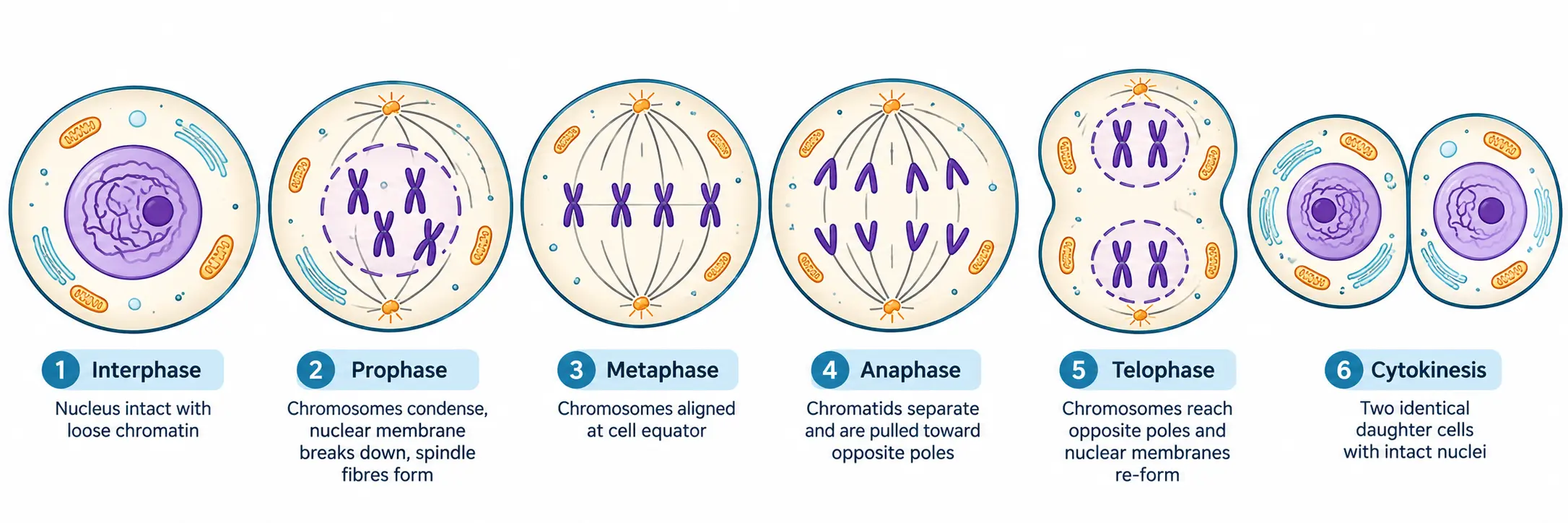
The difference is the last step. An animal cell pinches inward at the middle, its flexible membrane drawn in until it separates. A plant cell cannot pinch — a cellulose wall will not bend that way — so it builds a new wall across the middle instead, from the inside out. Same outcome, two different mechanics, and the cell wall is the reason.
The article on mitosis and meiosis goes through the stages properly and sets them against meiosis, which is the comparison most exams want. The mitosis worksheet and the mitosis practice pack are the practice; the Grade 12 cell cycle worksheet takes it further, into what happens when the controls on division fail.
What you actually see under a microscope
A textbook diagram shows every organelle at once. A school microscope shows almost none of them. At 400x in an onion-skin or cheek-cell slide you can expect the cell wall or membrane outline, the nucleus as a darker spot, and in leaf tissue the chloroplasts as distinct green dots. Mitochondria, ribosomes and the Golgi apparatus are beyond the resolution of a light microscope — they were worked out with electron microscopy.
Saying so in advance saves a frustrating lesson. It is worth having students draw what they can actually resolve and label it honestly, then compare that against the textbook diagram — the gap between the two is a useful lesson in how the diagram was arrived at in the first place.
Frequently asked questions
What is the main difference between plant and animal cells?
Plant cells have three structures animal cells lack: a rigid cell wall outside the membrane, chloroplasts for photosynthesis, and one large central vacuole. Animal cells have centrioles, which plant cells generally do not. Everything else — nucleus, mitochondria, ribosomes, membrane, cytoplasm — is in both.
Do animal cells have a cell wall?
No. Animal cells have only a cell membrane, which is flexible. That is why animal tissue is soft and why animals need a skeleton or a shell for support, while a plant can stand upright on the strength of its cell walls alone.
Do plant cells have mitochondria?
Yes. Plants respire just as animals do — they have to release the energy stored in the glucose their chloroplasts make. Chloroplasts capture energy; mitochondria release it. A plant cell needs both.
Why do only plant cells have chloroplasts?
Chloroplasts hold chlorophyll, which traps light energy to build glucose from carbon dioxide and water. Animals get their glucose by eating, so they have no use for the equipment. Not every plant cell has them either — root cells sit in the dark and generally do not.
What does the large vacuole in a plant cell do?
It stores water and pushes outward on the cell wall. That pressure, called turgor, is what holds a soft leaf or stem rigid — which is exactly why a plant wilts when it dries out and recovers when watered. Animal cells have small vacuoles at most.
Which organelles are in both plant and animal cells?
The nucleus, cell membrane, cytoplasm, mitochondria, ribosomes, endoplasmic reticulum, Golgi apparatus and lysosomes are present in both. These handle the work every eukaryotic cell has to do, regardless of whether it belongs to a plant or an animal.
Are plant cells bigger than animal cells?
Usually yes, and more regularly shaped. The cell wall holds a plant cell to a fairly fixed box-like outline, while an animal cell takes whatever shape its job demands — a nerve cell and a red blood cell look nothing alike.
Free cell worksheets and quizzes
Last updated: October 2026 · Written for Grades 7–10 biology students, teachers and homeschoolers. Every worksheet and quiz linked here is free and needs no account.