Verbs Explained: Types, Forms and Examples
Verbs are the engine of a sentence — no verb, no sentence. This guide covers the three main types, what happens either side of them, the four forms every verb has, and the errors that actually lose marks.
What a verb is
A verb says what the subject does, or what it is. Every complete sentence needs at least one, which is the quickest test for whether a string of words is a sentence or a fragment.
"The dog barked" has one. "The dog in the garden with the red collar" has none — it is a long noun phrase pretending to be a sentence. The fragments and run-ons quiz drills exactly that distinction, and it is the single most useful thing a middle-grade writer can fix.
Be careful with the obvious test, though. Not every verb describes an action. In "she is a nurse" and "the answer seems obvious", nothing is being done at all — which is why "a doing word" is a definition students outgrow quickly.
The three main types
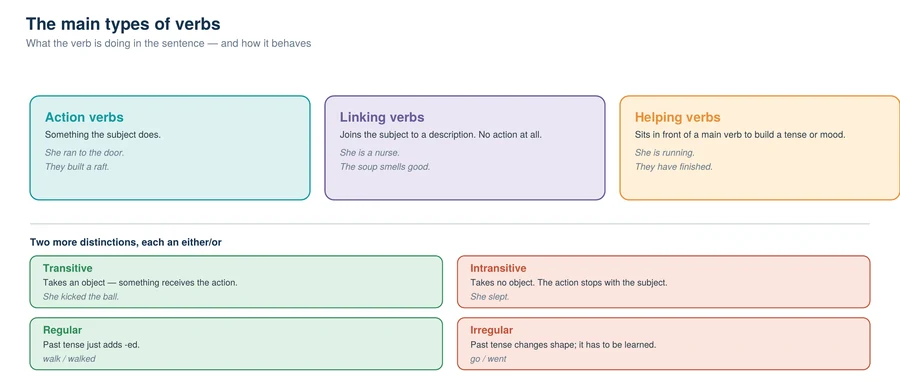
Action verbs are what people expect: something the subject does, whether physical (ran, built) or mental (thought, decided).
Linking verbs join the subject to a description instead. Be is the main one, along with seem, become, appear, and the sense verbs look, feel, taste, smell and sound. The word after a linking verb points back at the subject, which is why it takes an adjective: "the soup tastes good", never "tastes well". The guide to adjectives covers that from the other side.
Helping verbs sit in front of a main verb to build a tense or a mood: is running, have finished, will go, should know. The main ones are forms of be, have and do, plus the modals (can, could, may, might, must, shall, should, will, would).
The same word changes type. Be, have and do are all three at once depending on the sentence. "I have a bike" is an action; "I have finished" is helping; "she is tired" is linking. Type is a question about the sentence, not about the word.
Transitive and intransitive
An action verb either passes its action on to something or it does not.
Transitive ones take an object: "she kicked the ball". Ask "kicked what?" and there is an answer. Intransitive ones take none: "she slept". Ask "slept what?" and the question makes no sense.
Plenty of words do both. "She sings" is intransitive; "she sings hymns" is transitive. So the label belongs to the use, not to the dictionary entry — which is why exam questions always give you a full sentence to judge.
The four principal parts
Every verb has four forms, and every tense in English is built from one of them.
| Part | Regular example | Used for |
|---|---|---|
| Base | walk | Present simple, the infinitive, after a modal |
| Past | walked | Past simple |
| Past participle | walked | All perfect forms, and the passive |
| Present participle | walking | All continuous forms |
For regular verbs the past and past participle are identical, so the distinction looks academic. It stops looking academic the moment an irregular one turns up. The guide to English tenses shows how all twelve tenses are assembled from these four.
Irregular verbs
Roughly 200 verbs do not form their past with -ed, and there is no rule to derive them. They simply have to be learned.
| Base | Past | Past participle | Watch for |
|---|---|---|---|
| go | went | gone | "have went" is the classic error |
| do | did | done | "have did" likewise |
| see | saw | seen | "I seen it" is dialect, not standard |
| write | wrote | written | Three distinct forms |
| bring | brought | brought | Never "brang" |
| lie / lay | lay / laid | lain / laid | Two different words, constantly swapped |
The frustrating part is that irregular ones are the most common words in the language, so they cannot be avoided. The Cambridge Dictionary grammar pages carry a fuller list if you want one to work from. The confused-words worksheet picks up the pairs students mix most, lie and lay among them.
Agreeing with the subject
A verb has to match its subject in number. "The dog runs"; "the dogs run". Simple enough until something sits between the two.
- "The box of apples is heavy." The subject is box, not apples. Singular.
- "Each of the students has a copy." Each is singular, however many students there are.
- "Neither the teacher nor the pupils were ready." With either/or and neither/nor, match whichever subject is nearer.
Find the real subject first, then choose. The subject-verb agreement quiz is built around exactly these traps, and the sentence types quiz helps when long sentences make the subject hard to locate.
Active and passive
Voice is about which end of the action the sentence puts first, and it is handled by the verb.
Active: "The dog chased the ball." The subject does the action. Passive: "The ball was chased by the dog." The subject receives it. The passive is built from a form of be plus the past participle — which is the third reason that participle matters.
Only transitive verbs can go passive. There is no object in "she slept", so there is nothing to promote to the front, and no passive version of it exists.
Student writing is usually marked down for overusing the passive, and the advice to "always write actively" is too blunt. The passive is the right choice when the doer is unknown ("the window was broken"), irrelevant ("the samples were heated to 60°C"), or deliberately left out. Science writing uses it constantly and correctly. What gets marked down is the passive used by accident, where it buries who did what.
What gets taught at each grade
| Level | Usually expected | Practice |
|---|---|---|
| Grades 1–3 | Verbs are doing words; find them in a sentence; simple past and present. | Verbs quiz, Grade 2 |
| Grades 4–6 | Helping verbs, irregular past forms, keeping one tense, basic agreement. | Verb tenses quiz |
| Grades 7–10 | Linking against action, transitive against intransitive, agreement under tricky subjects, active and passive. | Grammar quiz, Grades 6-8 |
The present tense worksheet and the interactive sentence writing activity suit the younger end; the Grades 3-8 grammar quiz works as mixed revision across the middle. The guide to nouns is worth having alongside any of them, since subject and object are noun jobs.
Five mistakes that cost marks
"I have went." The perfect needs the past participle: I have gone. Same for did/done and saw/seen.
"The box of apples are heavy." Agreement with the nearest noun instead of the real subject.
"The soup tastes well." After a linking verb you need an adjective: tastes good.
"She walks in and sat down." Tense shifting mid-sentence. Pick one and hold it.
Leaving the verb out entirely. A fragment with no verb is the most heavily penalised error of the set, and the easiest to catch on a reread.
Frequently asked questions
What is a verb?
A verb is the word that says what the subject does or is. Every complete sentence needs at least one. In "the dog barked", barked is the verb; in "the dog is old", is does the same job without describing an action.
What are the three main types of verbs?
Action verbs say what the subject does (ran, built). Linking verbs join the subject to a description without any action (is, seems, became). Helping verbs sit in front of a main verb to build a tense or mood (is running, have finished, will go).
What is the difference between transitive and intransitive verbs?
A transitive verb takes an object — something receives the action: "she kicked the ball". An intransitive verb takes none: "she slept". Many words work both ways depending on the sentence, so it is a property of the use rather than the word.
What are the principal parts of a verb?
The base form (walk), the past (walked), the past participle (walked) and the present participle (walking). Every tense is built from one of these four, which is why the participles matter so much for the perfect and continuous forms.
What makes a verb irregular?
Its past and past participle cannot be predicted by adding -ed. Go becomes went and gone; write becomes wrote and written. About 200 are in common use, and because they are the most frequently used words in English, they cannot be avoided.
What is subject-verb agreement?
The verb has to match its subject in number: "the dog runs" but "the dogs run". It gets tricky when words sit between the two — in "the box of apples is heavy", the subject is box, not apples, so the verb is singular.
Can a word be both a noun and a verb?
Often. Run, light, water, book and hundreds of others work as either, and only the sentence decides. "Book a table" uses book as a verb; "read the book" uses it as a noun. Ask what job the word is doing rather than trying to memorise a category for it.
Free verbs worksheets and quizzes
Last updated: October 2026 · Written for Grades 2–10 students, teachers and homeschoolers. Every worksheet and quiz linked here is free and needs no account.