Adjectives Explained: Types, Order and Examples
Adjectives are the words that describe nouns — and the one thing almost nobody is taught is that when you use several at once, English puts them in a fixed order. This guide covers the types, that order, and the handful of mistakes that actually cost marks.
What an adjective is
An adjective describes a noun or a pronoun. It answers one of four questions about it: which one, what kind, how many, or whose.
- Which one? that chair, the second chair
- What kind? a wooden chair, a broken chair
- How many? three chairs, several chairs
- Whose? my chair, their chair
That test is more reliable than trying to recognise adjectives by how they look. Words do not belong to one part of speech for life — light is an adjective in "a light jacket", a noun in "turn on the light", and a verb in "light the candle". What it is doing in that sentence decides. The guide to nouns covers the other half of the pair.
The types of adjectives
| Type | What it does | Examples |
|---|---|---|
| Descriptive | Gives a quality. Most adjectives are these. | red, loud, enormous, careful |
| Quantitative | Says how much or how many. | three, several, many, few |
| Demonstrative | Points at which one. | this, that, these, those |
| Possessive | Says whose. | my, your, his, their |
| Interrogative | Asks about the noun. | which, what, whose |
| Proper | Made from a proper noun, so it keeps its capital. | Italian, Shakespearean, Victorian |
| Articles | Marks the noun as specific or general. | a, an, the |
Do not spend long memorising this table. Exams ask you to find adjectives far more often than to name their type, and the four-question test finds all seven kinds. The adjectives worksheet drills exactly that. The adjectives quiz marks itself.
The distinction worth getting right. Demonstrative and possessive adjectives sit in front of a noun: "this book", "my book". The same words used instead of the noun are pronouns: "this is mine". Same word, different job — and that is what the question is usually testing.
The order adjectives go in
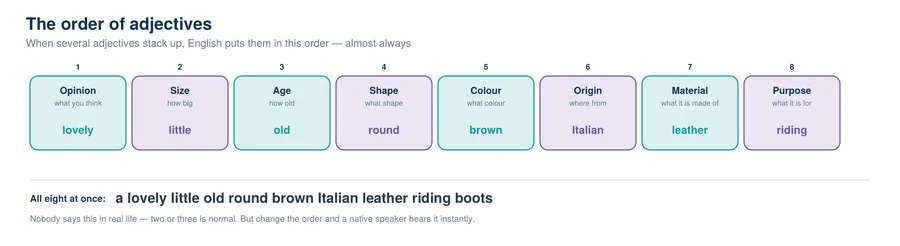
This is the part that surprises people. When several adjectives describe one noun, English puts them in a fixed sequence: opinion, size, age, shape, colour, origin, material, purpose. Nobody is formally taught it, and nearly every native speaker follows it anyway.
Which is why "a brown little dog" sounds wrong while "a little brown dog" sounds normal. Both are made of correct words. Only one follows the order. The Britannica Dictionary sets out the same sequence if you want a second source.
You will almost never use more than three at once. The order still applies to those three: size before colour, age before material, opinion before everything.
Comparatives and superlatives
Adjectives change shape when you compare things. A comparative compares two; a superlative picks one out of three or more.
| Adjective | Comparative (of two) | Superlative (of three or more) |
|---|---|---|
| tall | taller | tallest |
| happy | happier | happiest |
| careful | more careful | most careful |
| good | better | best |
| bad | worse | worst |
The rule of thumb: one-syllable words add -er and -est; words of three or more syllables take more and most. Two-syllable words go either way, and the ear decides. Good, bad, far and little are irregular and simply have to be known.
Never use both. "More taller" and "most biggest" are the single most common error in this topic. Pick one route or the other.
Before the noun, or after the verb
Most adjectives sit directly in front of the noun they describe: "the red door". Grammarians call that attributive position.
But an adjective can also follow a linking verb and point back at the subject: "the door is red". That is predicate position, and red is doing exactly the same job — describing door — from a different place in the sentence. Recognising that second pattern is what stops students missing adjectives in a "find all the adjectives" exercise. The guide to verbs covers linking verbs properly.
Telling them apart from adverbs
This is the distinction that causes the most trouble, and it has a one-line test: ask what the word is describing.
If it describes a noun, it is an adjective. If it describes a verb, an adjective, or another adverb, it is an adverb. "She is a quick runner" describes runner, a noun. "She runs quickly" describes runs, a verb.
The confusion comes from the -ly habit. Most adverbs end in -ly, so students start treating -ly as the test. It is not. Friendly, lovely, lonely and silly all end in -ly and all describe nouns. Meanwhile fast, hard, late and straight work as both, unchanged: "a fast car" against "she drove fast".
Linking verbs are the other trap. After is, seems, feels, tastes or smells, the describing word points back at the subject, so it takes the adjective: "the soup tastes good", not "tastes well". Say "tastes well" and you have claimed the soup has a sense of taste. The types of sentences quiz is useful here, since spotting the verb type is what makes the choice obvious.
Using them well in writing
Knowing what an adjective is and using one well are different skills, and the second is what writing marks actually reward.
The common advice to "add more describing words" produces worse writing, not better. A sentence carrying four of them in a row reads as padding: the big old scary dark house. One precise word usually beats three vague ones — derelict does more work than all four.
Three habits worth teaching alongside the grammar:
- Prefer the specific one. Freezing rather than very cold; ancient rather than really old. If an intensifier is propping the word up, the word is too weak.
- Let the noun and verb carry the weight. "He walked slowly to the broken old gate" is weaker than "he trudged to the rotting gate".
- Cut any that repeat the noun. A round circle and a frozen icicle tell the reader nothing they did not already have.
Good description is a selection problem rather than a quantity problem — which is the same lesson behind most of the writing rubric.
What gets taught at each grade
| Level | Usually expected | Practice |
|---|---|---|
| Grades 1–3 | Adjectives are describing words; find them in a sentence; use them in writing. | Adjectives quiz |
| Grades 4–6 | Comparatives and superlatives, adjective versus adverb, adjectives after linking verbs. | Grammar quiz, Grades 3-8 |
| Grades 7–8 | Naming the types, order of adjectives, and using them precisely rather than heavily in writing. | Grammar quiz, Grades 6-8 |
The Grade 6 confused-words worksheet and the Grade 8 one are worth adding here, because a good share of adjective errors at this level are really confused-word errors — fewer against less, good against well.
Four mistakes that cost marks
Doubling the comparison. "More easier" and "most fastest" are wrong. Use -er/-est or more/most, never both.
Using an adjective where an adverb belongs. "She sings beautiful" should be "she sings beautifully" — the word is describing sings, a verb, so it needs the adverb.
Comparing two things with a superlative. With exactly two, use the comparative: "the taller of the two", not "the tallest of the two".
Lowercasing proper adjectives. Italian, Canadian and Shakespearean keep the capital they inherited from the proper noun.
Frequently asked questions
What is an adjective?
An adjective is a word that describes a noun or pronoun — it tells you which one, what kind, how many, or whose. In "the red door", red is the adjective and door is the noun it describes.
What are the main types of adjectives?
The usual school list is descriptive (red, loud), quantitative (three, several), demonstrative (this, those), possessive (my, their), interrogative (which, whose), proper (Italian, Victorian) and articles (a, an, the). Most adjectives you meet are descriptive ones.
What order do adjectives go in?
Opinion, size, age, shape, colour, origin, material, purpose, then the noun. "A lovely little old round brown Italian leather riding boot" follows it exactly. Native speakers follow this order without being taught it, which is why "a brown little dog" sounds wrong even though every word is correct.
What is the difference between a comparative and a superlative?
A comparative compares two things and usually ends in -er or takes "more": taller, more careful. A superlative picks one out of three or more and ends in -est or takes "most": tallest, most careful. Use -er and -est for short words, more and most for long ones.
Can an adjective come after the noun?
Yes, when it follows a linking verb. In "the door is red", red still describes door but sits after the verb instead of in front of the noun. Grammarians call that a predicate adjective.
Is "the" an adjective?
Technically yes — articles (a, an, the) are a small class of determiners that many school grammars count as adjectives, because they tell you which noun is meant. Some courses teach them as determiners instead, so follow whichever your class uses.
How do I tell an adjective from an adverb?
Ask what the word is describing. An adjective describes a noun; an adverb describes a verb, an adjective or another adverb. "She is a quick runner" uses the adjective quick to describe runner; "she runs quickly" uses the adverb quickly to describe runs.
Free adjectives worksheets and quizzes
Last updated: October 2026 · Written for Grades 2–8 students, teachers and homeschoolers. Every worksheet and quiz linked here is free and needs no account.