English Tenses: All 12 Explained with a Chart
The twelve English tenses look like twelve separate things to memorise. They are not. They are three times multiplied by four aspects, and once you can see the grid, you can build any form you need rather than recalling it.
All 12 English tenses in one chart
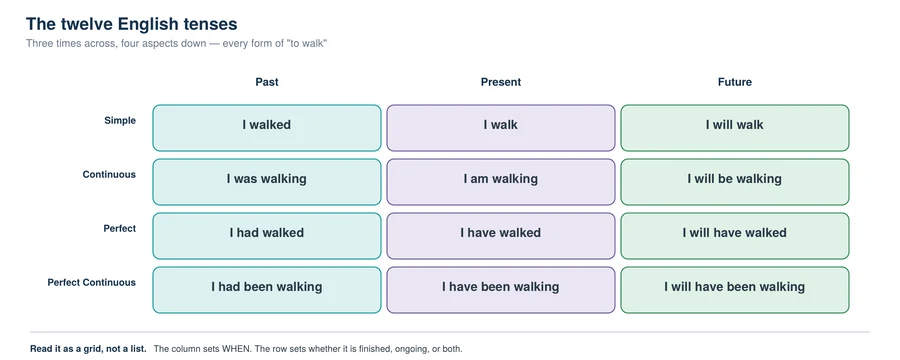
Read it as a grid, not a list. The column tells you when. The row tells you whether the action is treated as a finished point, as something in progress, as completed before a later moment, or as both ongoing and consequential.
Every cell is the same verb. Nothing changes except the auxiliaries in front of it and which of its principal parts is used. Master that pattern and the twelve stop being a list.
That is the whole claim of this guide: the English tenses are a system with two inputs, not twelve items to be memorised one at a time. Students who learn them as a list can usually name a form but not choose one. Students who learn the grid can do both.
The three times
Past is over. Present is now, or habitually true. Future has not happened.
One honest complication: English has no future ending. There is no equivalent of adding -ed for the future — we borrow will, or going to, or simply use the present ("the train leaves at six"). Linguists therefore argue English has only two real tenses. School grammars keep the future anyway, because the twelve-cell grid is the most useful way to teach the system. The Purdue OWL makes the same point: only present and past are carried by the verb alone.
The four aspects
If the three times are the easy half of the English tenses, aspect is the half that decides meaning.
Aspect is the part students are rarely taught by name, and it is the part that actually decides the meaning.
- Simple — treats the action as a whole. I walked.
- Continuous — in progress at that moment. I was walking. Formed with be plus the -ing form.
- Perfect — completed before the time you are talking about. I had walked. Formed with have plus the past participle.
- Perfect continuous — was going on, and it matters now. I had been walking.
The pattern worth stating out loud. Be plus -ing always means continuous. Have plus the past participle always means perfect. Both together means both. That is the entire construction system — three rules covering all twelve cells.
The verb tenses quiz is the most direct practice for this. The present tense worksheet starts younger, with the present forms alone.
Choosing between the simple and the perfect
This is where most marks are lost, and the rule is narrower than it looks.
Use the past simple when the time is finished and usually stated: I finished it yesterday. Use the present perfect when the time is not stated, or the result still stands: I have finished it.
The hard edge: if a specific past time is named, the present perfect is simply wrong. "I have finished it yesterday" is ungrammatical, not merely awkward. Yesterday closes the window, and the present perfect needs it open.
| Sentence | Correct? | Why |
|---|---|---|
| I have seen that film last week. | No | "Last week" names a finished time — use I saw. |
| I have seen that film. | Yes | No time stated; the experience still counts now. |
| She has lived here since 2019. | Yes | Started in the past and is still true. |
| She lived here since 2019. | No | "Since" needs a perfect form. |
Irregular verbs
Every form above is built from three principal parts: the base (walk), the past (walked) and the past participle (walked). For regular verbs the last two are identical and predictable.
For irregular ones they are not, and there is no rule to fall back on.
| Base | Past | Past participle |
|---|---|---|
| go | went | gone |
| see | saw | seen |
| write | wrote | written |
| bring | brought | brought |
| cut | cut | cut |
The third column is the one students skip, and it is the one the perfect forms need. Knowing went but not gone produces "I have went", which is the single most recognisable error in this topic. The guide to verbs covers the parts in more detail.
Staying in one tense
Beyond building forms correctly, writing is marked on holding one consistently.
"She walks into the room and sat down" shifts for no reason, and it is extremely common in student narrative. Pick past or present for a piece and hold it; change only where the timing genuinely changes, such as a flashback or a statement that is permanently true.
Agreement is the related skill: the verb has to match its subject in number as well as sit in the right tense. The subject-verb agreement quiz drills that directly, and the fragments and run-ons quiz catches the sentence errors that usually travel with it. The interactive sentence writing activity is a gentler starting point for younger writers.
What gets taught at each grade
| Level | Usually expected | Practice |
|---|---|---|
| Grades 1–3 | Past, present and future simple; regular -ed endings; the commonest irregulars. | Verbs quiz, Grade 2 |
| Grades 4–6 | Continuous and perfect forms, irregular past participles, keeping one tense across a paragraph. | Verb tenses quiz |
| Grades 7–10 | All twelve English tenses by name, present perfect against past simple, and agreement under tricky subjects. | Grammar quiz, Grades 6-8 |
The Grades 3-8 grammar quiz is useful mixed revision across the middle of that range, and the confused-words worksheet picks up the word-choice errors that often get marked as grammar.
Five mistakes that cost marks
Almost every error in English tenses at school level is one of these five.
"I have finished it yesterday." A stated past time rules out the present perfect. Use the past simple.
"I have went." The perfect needs the past participle, not the past: I have gone.
"She lived here since 2019." Since and for pull a perfect form: she has lived.
Shifting tense mid-paragraph. Choose one and hold it unless the timing actually moves.
Using the continuous with a state verb. Know, believe, own and like describe states, not actions, so "I am knowing the answer" is wrong. States take the simple form.
Frequently asked questions
How many English tenses are there?
Twelve, in the way schools usually count them: three times (past, present, future) multiplied by four aspects (simple, continuous, perfect, perfect continuous). Strictly, English marks only two tenses on the verb itself — present and past — and builds everything else with auxiliaries, which is why you will sometimes see a smaller number.
What is the difference between tense and aspect?
Tense is when it happened; aspect is how it sits in time. "I walked" and "I was walking" are both past, but the first treats the action as a finished point and the second as something in progress. Choosing a tense means choosing both.
When do I use the present perfect instead of the past simple?
Use the past simple for something finished at a stated time: "I finished it yesterday". Use the present perfect when the time is unstated or the result still matters: "I have finished it". If a specific past time is named, the present perfect is wrong.
What is the perfect continuous used for?
It describes something that was going on for a while and has a result you can still see. "I had been walking for an hour" explains why the speaker was tired. It joins duration to consequence, which no other form does in a single phrase.
Why are irregular verbs so hard?
Because their past and past participle forms cannot be worked out from the base — go becomes went and gone, not "goed". There are roughly 200 in common use and they have to be learned as a list. The good news is that the irregular ones are the most frequent verbs, so they come up constantly.
What does it mean to shift tense?
Changing from one tense to another without a reason, usually mid-paragraph: "She walks into the room and sat down." Pick past or present for a piece of writing and hold it, changing only when the timing genuinely changes.
Does English really have a future tense?
Not in the strict sense. English has no future ending on the verb; it uses "will" plus the base form, or "going to", or even the present tense ("the train leaves at six"). School grammars still teach a future tense because it is a useful way to organise the twelve forms.
Free English tenses worksheets and quizzes
Last updated: October 2026 · Written for Grades 3–10 students, teachers and homeschoolers. Every worksheet and quiz linked here is free and needs no account.