Cellular Respiration: Equation, Stages and ATP
Every cell in every living thing runs this reaction, all the time. It is how the energy locked in food becomes energy a cell can actually spend — and it is the photosynthesis equation played backwards.
The equation
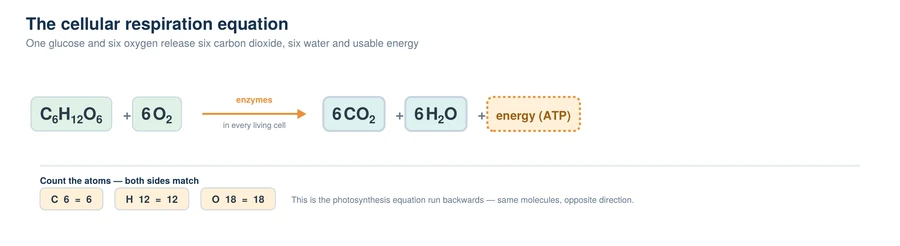
Glucose reacts with oxygen to give carbon dioxide, water and energy. The atoms balance: six carbon in, six carbon out; twelve hydrogen each side; eighteen oxygen each side once you count the oxygen already inside the glucose. Nothing is created or destroyed — the bonds are simply rearranged into a lower-energy arrangement, and the difference is what the cell captures.
Energy sits outside the balance because it is not a molecule. What the cell actually ends up with is ATP, adenosine triphosphate, the small rechargeable carrier that powers almost everything a cell does. The cellular respiration worksheet works through the equation term by term.
Respiration is not breathing
This is the single most common confusion, and it is worth settling before anything else. Breathing is mechanical: the diaphragm moves, air enters the lungs, gases cross into and out of the blood. Respiration is chemical, happens inside every one of your cells, and would continue for a short while even if you stopped breathing.
They are connected, not identical. Breathing delivers the oxygen that respiration consumes and carries away the carbon dioxide it produces. The respiratory system quiz covers the mechanical side; this article is about the chemical one.
A test that settles it. A plant carries out cellular respiration. A plant does not breathe. If a definition you have written would apply to a plant, you are describing respiration; if it involves lungs, you are describing breathing.
The three stages
Glycolysis, in the cytoplasm
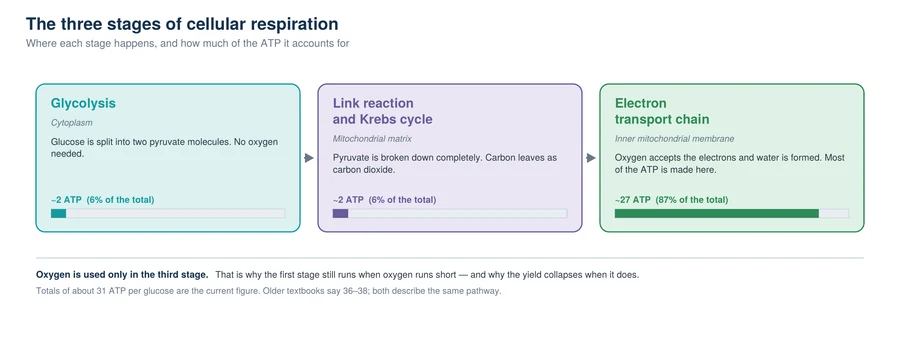
Glucose, a six-carbon sugar, is split into two three-carbon molecules of pyruvate. This costs 2 ATP to start and returns 4, for a net gain of 2. Crucially, no oxygen is involved — which is why this stage keeps running when oxygen is short, and why it is thought to be the oldest part of the pathway.
Link reaction and Krebs cycle, in the mitochondrial matrix
Pyruvate moves into the mitochondrion and is broken down completely. The carbon leaves as carbon dioxide — this is where the CO₂ you exhale is actually produced. Only 2 ATP are made directly, but the stage loads up electron carriers, and those carriers are what the next stage spends.
The electron transport chain, on the inner membrane
The loaded carriers hand their electrons to a chain of proteins embedded in the inner mitochondrial membrane. The energy released is used to pump protons across the membrane, and letting them flow back drives ATP synthesis. At the end of the chain, oxygen accepts the spent electrons and becomes water.
That last step is why you need oxygen. Not to burn glucose directly — to clear the end of the chain. Without an acceptor the chain backs up, the carriers stay loaded, and everything downstream of glycolysis stops.
Why your textbook’s ATP total may not match
Older textbooks say 36 to 38 ATP per glucose. Newer ones say about 30 to 32. Neither is a misprint, and the pathway has not changed.
The difference is accounting. The number of protons the chain must pump per ATP made was revised upward as the structure of ATP synthase became clear, and some of the proton gradient is spent moving molecules across the mitochondrial membrane rather than on ATP. Count those costs and the yield falls. If an exam board states a figure, use theirs; if a question asks you to explain the discrepancy, this is the answer.
When the oxygen runs out
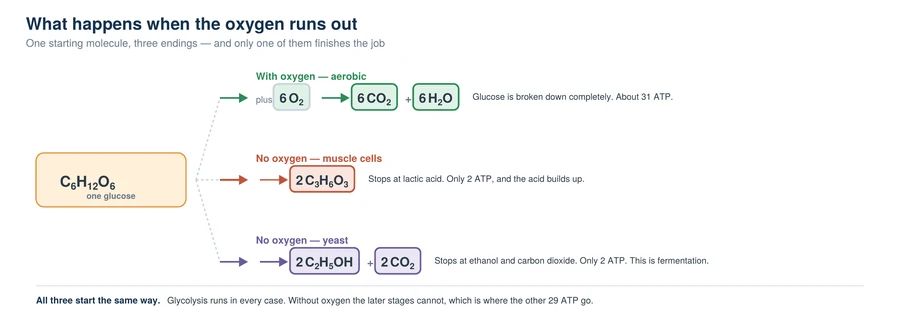
Glycolysis runs regardless. The later stages cannot, so the cell is left with 2 ATP instead of about 31 — roughly a fifteenth of the yield from the same glucose. It also has pyruvate piling up and nowhere to send it.
Human muscle converts it to lactic acid. Yeast converts it to ethanol and carbon dioxide, which is why bread rises and beer exists. Both routes exist for the same reason: they regenerate the carrier that glycolysis needs, so at least that first stage can keep turning.
The cellular respiration quiz covers both routes. The enzymes quiz is worth doing alongside, since every step here is enzyme-controlled and exam questions often approach respiration through enzyme behaviour.
The photosynthesis link
Set the two equations side by side and they are mirror images. Photosynthesis takes carbon dioxide and water and, using light, builds glucose and oxygen. Respiration takes glucose and oxygen and returns carbon dioxide and water. One stores energy; the other releases it.
Plants do both. Animals do only the second, which is why animals have to eat. At the scale of an ecosystem the two processes are a closed loop, with sunlight entering at one end and heat leaving at the other. The photosynthesis article covers the storing half, the photosynthesis worksheet and the photosynthesis quiz give practice on it, and the food chains worksheet sets the loop in its ecological context.
What gets asked at each grade
| Level | Usually expected | Practice |
|---|---|---|
| Grades 7–8 | Cells release energy from food using oxygen; mitochondria are where it happens; respiration is not breathing. | Energy quiz |
| Grades 9–10 | The balanced equation, aerobic versus anaerobic, the role of mitochondria, and lactic acid in muscle. | Cellular respiration worksheet |
| Grades 11–12 | The stages by name, what each yields, chemiosmosis and the proton gradient, and why the ATP total is approximate. | Cellular respiration quiz |
The article on plant and animal cells is useful background at any of these levels — respiration questions assume you know what a mitochondrion is and which cells have them. The digestive system quiz covers how the glucose gets there in the first place.
Five mistakes that cost marks
Calling respiration “breathing”. Examiners watch for this specifically. Respiration is a chemical reaction in cells.
Saying plants do not respire. They respire constantly, including in full sunlight while photosynthesising at the same time.
Putting glycolysis in the mitochondria. It is in the cytoplasm. That detail is the reason anaerobic respiration is possible at all.
Saying oxygen is used to burn glucose. Oxygen is used at the very end, to accept electrons and form water. Describing it as combustion loses the mechanism.
Treating 38 ATP as a fact. It is one accounting convention among several. Say “about 30 to 32”, or quote whichever figure your course uses, and know why they differ.
Frequently asked questions
What is the equation for cellular respiration?
Glucose plus oxygen gives carbon dioxide plus water plus energy: C6H12O6 + 6O2 → 6CO2 + 6H2O. The energy is not a molecule in the equation, which is why it is usually written on the end rather than balanced — it is captured as ATP.
Is cellular respiration the same as breathing?
No. Breathing is the physical movement of air into and out of the lungs. Cellular respiration is a chemical process inside every cell, releasing energy from glucose. Breathing supplies the oxygen that respiration needs and removes the carbon dioxide it makes, but they are different things at different scales.
Where does cellular respiration take place?
The first stage, glycolysis, happens in the cytoplasm. The link reaction and Krebs cycle happen in the mitochondrial matrix, and the electron transport chain is on the inner mitochondrial membrane. Only the first stage happens outside the mitochondria.
How much ATP does cellular respiration produce?
About 30 to 32 ATP per glucose molecule on current figures, of which the electron transport chain supplies the large majority. Older textbooks give 36 to 38 because they assumed a more efficient transport chain. Both numbers describe the same pathway.
Do plants carry out cellular respiration?
Yes, constantly, day and night. Photosynthesis stores energy in glucose; respiration releases it. A plant that only photosynthesised would have no way to use what it made. Plant cells have mitochondria for exactly this reason.
What is anaerobic respiration?
Respiration without oxygen. Glycolysis still runs, but the later stages cannot, so the yield drops to 2 ATP. In human muscle the leftover pyruvate becomes lactic acid; in yeast it becomes ethanol and carbon dioxide, which is fermentation.
Why do muscles ache after hard exercise?
During intense effort your muscles use oxygen faster than your blood can supply it, so they switch to anaerobic respiration and lactic acid builds up. The burning sensation during the effort is associated with that build-up; the soreness a day or two later is mostly muscle repair, not acid.
Free respiration worksheets and quizzes
Last updated: October 2026 · Written for Grades 9–12 biology students, teachers and homeschoolers. Every worksheet and quiz linked here is free and needs no account.