Customary Unit Conversions
This customary units conversion worksheet gives Grade 4 to Grade 6 students 26 marks of practice on inches, feet, yards and miles, ounces and pounds, and the cup to gallon capacity ladder.
This customary units conversion worksheet gives Grade 4 to Grade 6 students 26 marks of practice on inches, feet, miles, ounces, pounds and the cup to gallon capacity ladder.
What the customary units conversion worksheet covers
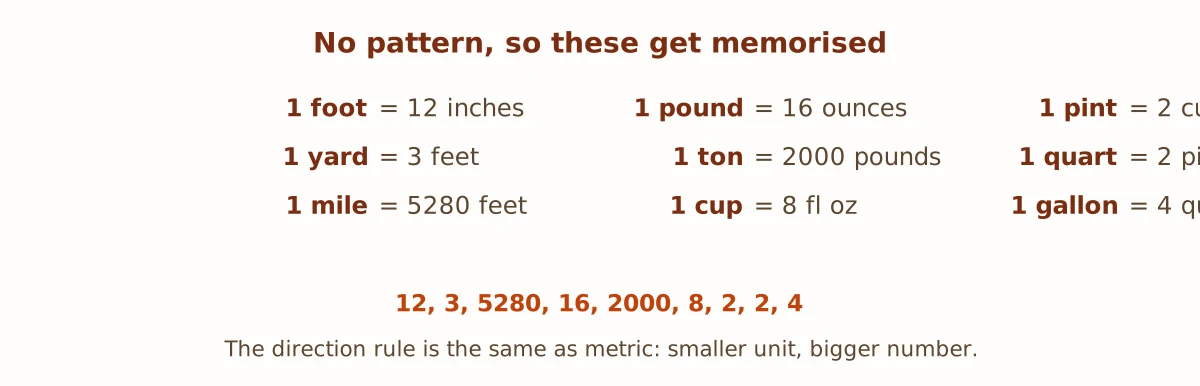
Customary units were never designed as a system. Inches, pounds and gallons grew out of everyday objects and trade over several centuries, so the numbers between them follow no pattern: twelve inches to a foot, three feet to a yard, sixteen ounces to a pound, 5280 feet to a mile.
That has a direct consequence for how they are taught. There is no ladder and no decimal point to shift, so these conversions have to be memorised and the arithmetic done properly. A student who has learned metric conversions by moving the decimal point will try the same move here and get nonsense, which is worth saying out loud before they start.
The one part that does have a pattern
Capacity doubles all the way up. Two cups make a pint, two pints make a quart, and then four quarts make a gallon. So a gallon is sixteen cups, and a student who notices the doubling does not have to memorise that number separately — they can rebuild it in a few seconds.
Part B is built around exactly this. Students convert two gallons into quarts, then into pints, then into cups, each answer building on the one above. Laid out as a chain the doubling is impossible to miss, and it converts four separate facts into one pattern.
Direction still works the same way
One thing does carry over from metric: going to a smaller unit always means a bigger number. Converting feet to inches multiplies; converting ounces to pounds divides. Part A mixes the two directions so students decide each time rather than applying whichever operation the previous question used.
The self-check is the same too. If 48 ounces turns into 768 pounds, something has gone the wrong way, and a student who pictures a bag of sand catches it without being told.
The numbers worth knowing by heart
Nine facts cover everything on this sheet: 12, 3 and 5280 for length; 16 and 2000 for weight; 8, 2, 2 and 4 for capacity. They are printed at the top of the worksheet so it can be used for independent practice, but the long-term goal is recall, because these come up in recipes, sports distances and shipping weights for the rest of a student's life.
The mile is the awkward one. 5280 has no memorable structure and simply has to be learned, which is why it appears twice on the sheet rather than once.
Where marks get lost
The commonest error is reaching for the decimal-point trick learned in metric work, turning 3 feet into 0.3 inches. The second is using the wrong fact entirely — sixteen appears in both ounces-to-pounds and cups-to-gallons, and students sometimes apply it to length. Saying both out loud before the sheet starts prevents most of them.
How to use this worksheet
The sheet prints on standard letter paper and runs about twenty-five minutes. It works well straight after the metric sheets, because the contrast is instructive: students see why a system built on powers of ten is easier, which is the argument for metric in one page.
Our guide to unit conversions has the full charts and the most-asked questions. The rest of our math worksheets cover metric length, mass and capacity and the conversions between the two systems. The NIST tables give the official customary to metric factors.
Practise customary unit conversions online
Answer these five questions and check them instantly. They use the same facts as the printable sheet.
- How many inches are in 3 feet?
- How many ounces are in 5 pounds?
- How many quarts are in 3 gallons?
- How many cups are in 1 gallon?
- How many feet are in a mile?