The Lost Ball
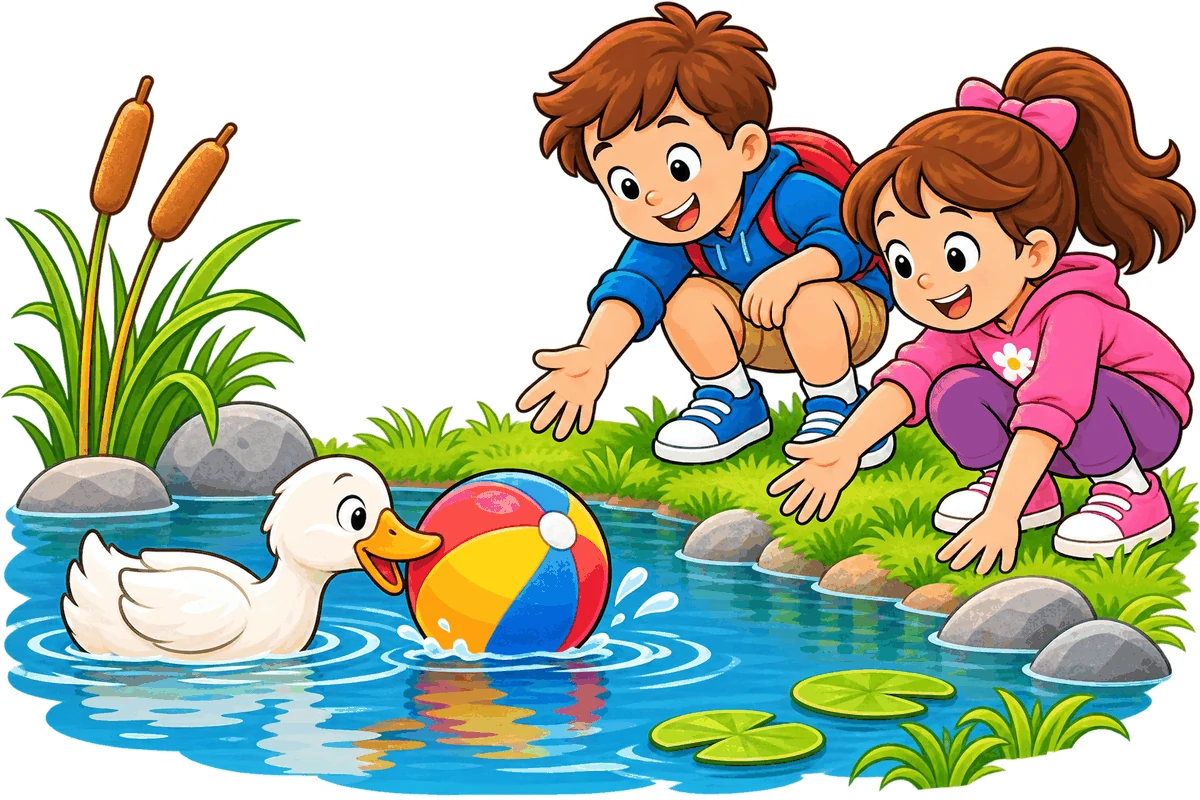
This wh questions reading comprehension worksheet gives Grade 1 students a short illustrated story about a ball lost in a pond, followed by five questions beginning with who, what, where and when.
This wh questions reading comprehension worksheet gives Grade 1 students a short illustrated story and five questions starting with who, what, where and when — each asking for a different kind of answer.
What the wh questions reading comprehension worksheet covers
Who, what, where and when are the four question words a first grader meets most, and the skill being practised is narrower than it looks. It is not finding information in a story. It is noticing that the first word of the question tells you what kind of answer to go looking for.
A child who answers "Saturday" to a where question has read the story perfectly well and has not read the question. That is the single most common error at this level, and it is why every question on this sheet begins with its question word in bold.
One kind of answer each
Who asks for a person or an animal. What asks for a thing. Where asks for a place. When asks for a time. The story is written so each of those has exactly one clear answer sitting in the text: Max and Lily, a new ball, in the water, on Saturday.
Two of the five questions start with "who" and have different answers — Max and Lily went to the pond, but a duck pushed the ball back. That repetition is deliberate. A child who has worked out that "who" means a person can get caught out when the answer is an animal, and meeting both on one sheet is how that gets sorted out.
Why the time reference comes first
"On Saturday" opens the passage, before anything happens. Beginning readers expect answers to appear in the order the questions are asked, so a when question whose answer sits in the very first words requires going back to the start rather than reading forward.
Going back to check is the strategy worth building here. Children often treat re-reading as an admission that they failed the first time, and it is worth saying plainly that looking back at the story is what good readers do.
A story with a problem and a solution
Unlike a beginning reader passage, this one has a small plot: a ball is kicked too hard, it ends up in the water, and a duck solves the problem. A child has to follow cause and effect across four sentences to answer the questions properly.
That makes it a step up from a passage that simply describes something. If a child finds this hard, the beginning reader passages in this set are the right place to go back to before trying again.
How to use this worksheet
The sheet prints on one page with answers on a second and takes about fifteen minutes. Short answers are the goal — "a duck" is a complete answer and asking for a full sentence turns a comprehension task into a handwriting task.
If a child gives the wrong type of answer, do not simply correct it. Point at the first word of the question and ask again. Almost every child self-corrects once they see that the question word is doing the work, and that realisation transfers to every comprehension question they meet afterwards.
For the next step, our English worksheets include sequencing and longer story passages, and the guide to Grade 1 reading passages explains the progression. The Reading Rockets comprehension pages cover the research behind question-asking strategies.
Try these questions online
Answer these five questions about the story and check them instantly.
- Who went to the pond?
- What did Max have?
- Where did the ball go?
- When did they go to the pond?
- Who pushed the ball back?