Fill in the Verbs Worksheets — Grade 2 and 3 | 10-Page Verb Practice Pack
A ten-page fill in the verbs pack for Grade 2 and 3, with eighty sentences and an answer key.
This fill in the verbs pack is ten printable pages in one download: present tense, past tense, irregular verbs, the helping verbs children mix up, and a mixed review.
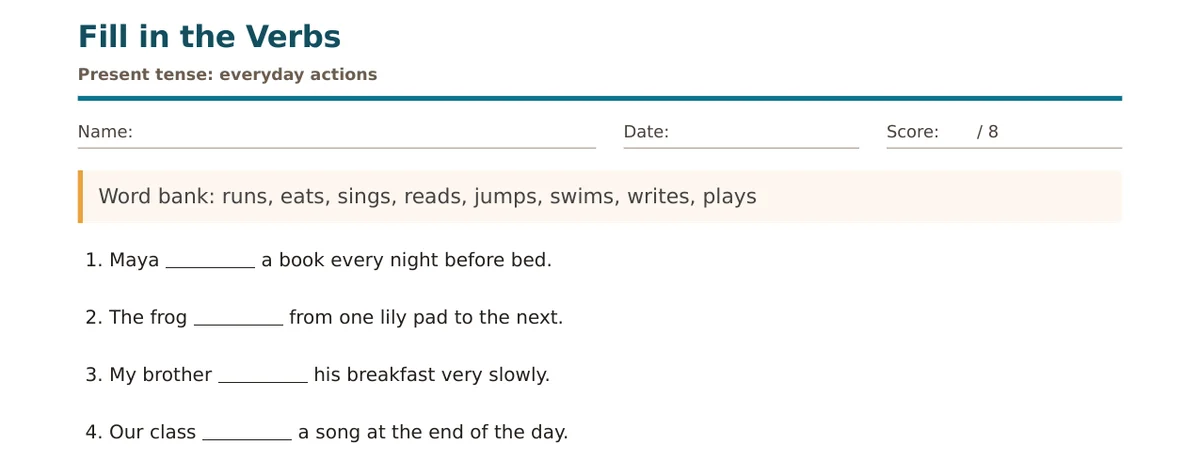
What is in this fill in the verbs pack
Eighty questions over ten pages, each page a single focus. Present tense first, then the -s ending, then regular past tense with -ed, then the irregular past-tense verbs that break the rule. After that come three pages on helping verbs — is/am/are, was/were, has/have — then -ing verbs, a page where grammar alone will not get you the answer, and a mixed review. An answer key covers every section.
Why ten pages and not ten worksheets
A verb sheet is only useful in sequence. A child who can fill in "the cat ___ on the windowsill" has not yet met "yesterday we ___ to the park", and the second needs the first.
Printing the set together means you hand out page three when page two is secure, rather than hunting for the next sheet. It also means the answer key lives in one place instead of eight.
The order is the lesson
Pages one and two are present tense, which children hear correctly long before they write it correctly. The only real difficulty is the -s on a single subject, and page two does nothing else.
Page three introduces -ed as a rule, and page four immediately breaks it. That sequence is deliberate: ate, went, saw and wrote cannot be reasoned out, and a child who has just learnt "add -ed" will write "eated" with real confidence. Meeting the exceptions straight after the rule is what stops that hardening.
The helping verbs are the hard part
Is/am/are, was/were and has/have get a page each because they are where most errors live, and because the rule is about the subject rather than the verb. "The books ___ on the shelf" needs are because books is plural, not because of anything about the verb itself.
Saying the sentence aloud catches most of it. Children hear "the books is on the shelf" as wrong long before they can explain why, and that ear is worth more than the rule.
The page that needs thinking
Page nine gives sentences where several verbs fit the grammar and only one fits the meaning. "A pilot ___ an aeroplane" would accept drives grammatically, and flies is the answer.
That distinction is the point of the page. Grammar is not the same thing as sense, and a child who has learnt to make a sentence agree still has to check that it means something.
How to use it
One page per sitting, ten to fifteen minutes each. Working straight through in a single session defeats the sequencing, which is most of the value.
For marking, the useful signal is which page a child stumbles on rather than the total. Errors concentrated on page four mean irregular verbs, not verbs; errors spread across six and seven mean subject–verb agreement. Those need different reteaching, and the layout of this pack is what makes them visible.
Where it goes next
Once the helping-verb pages are secure, subject–verb agreement in longer sentences is the next step, and it is the same rule applied where the subject sits further from the verb.
That is also the point at which reading aloud stops being enough, because the ear loses track across a long subject. Getting the short cases automatic first is what makes the long ones manageable.
For more, our English worksheets cover grammar, spelling and comprehension, and the complete guide to verbs explains every tense in one place. The Reading Rockets writing pages cover the research behind grammar instruction.
Try a few before you print
Four questions from the pack.
- Maya ___ a book every night before bed.
- Yesterday I ___ my lunch at school. (eat)
- The books ___ on the shelf.
- A pilot ___ an aeroplane.