Consonant Blends Worksheets — Grade 1 and 2 Phonics Practice
Five pages of consonant blends worksheets covering 40 words, with an answer key.
These consonant blends worksheets cover the blends children meet first — bl, cr, st, sn and the rest — at the start and end of words, across five printable pages.
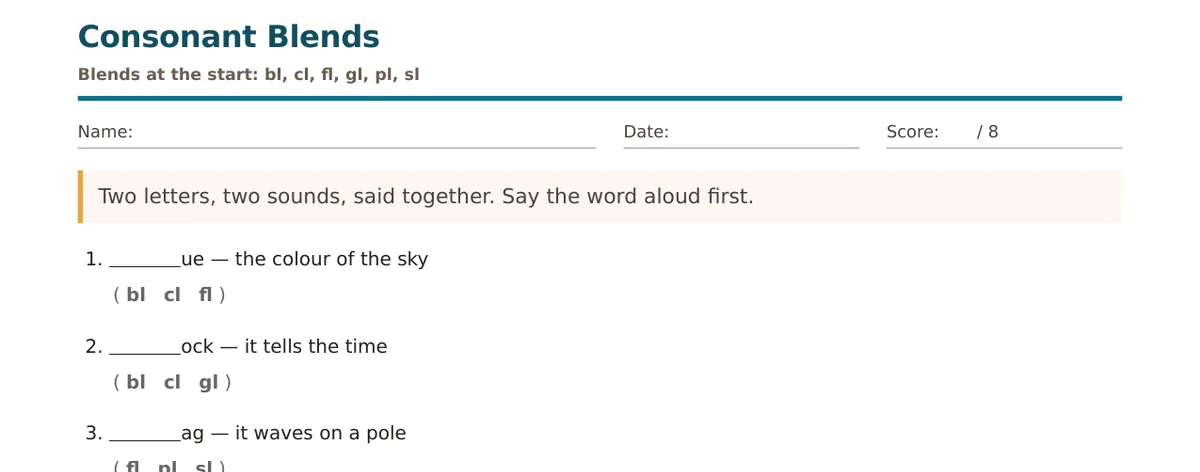
What is on these consonant blends worksheets
Forty words over five pages. Starting blends come first, grouped by family: the l blends (bl, cl, fl, gl, pl, sl), then the r blends (br, cr, dr, fr, gr, tr), then the s blends (sc, sk, sm, sn, sp, st, sw). Page four moves to blends at the end of a word, and page five mixes everything. Each word comes with a short clue and three blends to choose from.
A blend is not a digraph
This is the distinction that matters, and it is easy to blur. In a blend, both letters keep their own sound: bl in blue is a b and an l said quickly together. In a digraph, two letters make one new sound that neither letter makes alone — sh, ch, th.
Children who have been taught digraphs first sometimes try to find a single new sound in st and cannot. Saying the word slowly and stretching the opening is usually enough to show both sounds are there.
Why the clues are words, not pictures
Each item gives a clue such as "it waves on a pole" rather than a picture of a flag. A picture names itself, so a child can often answer without reading anything.
Working from a clue means decoding the word to check the answer, which is the skill the sheet is for. It also means the pages print cleanly in black and white and cost nothing to photocopy.
Blends at the end are harder
Page four is the one children find difficult, because a blend at the end of a word is quieter and easier to drop. Hand becomes han, jump becomes jum.
Exaggerating the ending when saying the word aloud is the fix, and it transfers straight to their writing. A child who drops the d in hand when speaking will usually drop it when spelling too.
Three choices, not a blank
An open blank tests recall and spelling at once, which means a child who knows the sound but not the spelling scores zero and learns nothing.
Three choices separate the two. The child hears the blend, then picks the letters that make it, and the wrong options are close enough that guessing does not pay — bl, cl and fl all sound plausible at the start of a word until you say it.
How to use them
One page per session, ten minutes, read aloud together for the first two or three items. Blends are a listening skill before they are a reading skill.
When marking, look at which family the errors cluster in. Mistakes spread across the r blends mean the r sound itself, which is a speech issue rather than a reading one, and reteaching the spelling will not touch it.
What comes after blends
Once blends are secure at both ends of a word, three-letter blends are the next step — str in street, spl in splash, scr in scratch.
They are not a new idea, only more of the same, and a child who can hear both sounds in st will hear all three in str without being taught anything further.
For more, our English worksheets cover phonics, spelling and early reading, and the phonics worksheets guide sets out an order to teach them in. The Reading Rockets phonics pages cover the research.
Try a few before you print
Four from this pack.
- ___ue — the colour of the sky (bl / cl / fl)
- ___ain — it runs on rails (tr / cr / fr)
- ha___ — you have five fingers on it (nd / nt / mp)
- ___ow — it falls in winter (sn / sl / sw)