Dissolving Candy Cane Experiment Worksheet
Free dissolving candy cane experiment worksheet for grades 2-4: predict, test cold, room and warm water, record results, graph and explain.
This free dissolving candy cane experiment worksheet turns a bag of candy canes into a real fair test for Grades 2 to 4. Children predict which water temperature will dissolve a candy cane fastest, test cold, room-temperature and warm water side by side, record what they observe, graph the results and explain what happened. Everything you need is already in the kitchen.
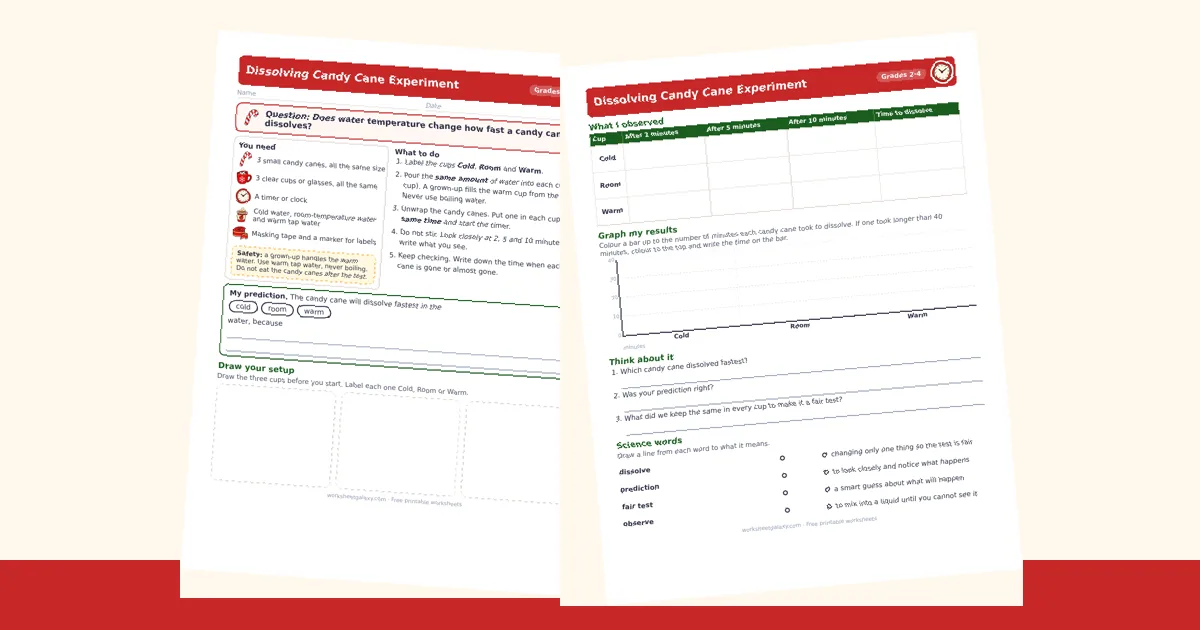
What is in this dissolving candy cane experiment worksheet
- Page 1 – Plan. The question, a picture materials list, safety note, five simple steps and a prediction box.
- Page 2 – Record. An observation table for 2, 5 and 10 minutes, a bar graph to colour, three think-about-it questions and a science words match.
- Page 3 – Teacher notes. What usually happens, the science explained simply, answers to the questions and ideas to try next.
How to run the dissolving candy cane experiment
- Use small candy canes that match. Mini candy canes work well and keep the test short.
- Measure the water with the same cup each time so the amount is the same.
- Start all three together. Drop the candy canes in at the same moment and start one timer.
- Do not stir. Stirring speeds things up and makes the test unfair, which is itself a great follow-up experiment.
The science behind the dissolving candy cane experiment
A candy cane is mostly sugar. When it sits in water, the water particles, which are always moving, knock sugar particles loose and spread them through the water. In warm water the particles move faster, so they hit the sugar more often and with more energy, and the candy cane dissolves sooner. This is a good first fair test for young scientists because only one thing changes, the water temperature, while the candy cane, the cup and the amount of water stay the same. Children also see that dissolving is not disappearing: the sugar is still there, and the water tastes sweet.
Frequently asked questions
How long does the dissolving candy cane experiment take?
Times depend on the size of the candy canes and how warm the water is. Mini candy canes in warm water often dissolve in well under an hour, and the cold one takes much longer, so plan for about 30 to 45 minutes and let the cold cup keep going while you discuss results.
Is the experiment safe for young children?
Yes, with a grown-up handling the warm water. Use warm tap water, never boiling, and do not eat the candy canes after the test.
What grades is this candy cane science worksheet for?
Grades 2 to 4. Younger children can do the experiment with a grown-up filling in the table; older children can add more times to the table and compare their graph with a partner.
Download the dissolving candy cane experiment worksheet above, print all three pages and grab some candy canes. For older students, try the candy cane chromatography lab on the Christmas worksheets hub.
Candy cane science quiz
Eight quick questions about dissolving and fair tests. Try them after the experiment.
All done!
0 / 8