Ordering Numbers Worksheets — Grade 2 and 3 | Ascending, Descending and Missing Numbers
Five pages of ordering numbers worksheets with 40 questions and an answer key.
These ordering numbers worksheets cover ascending and descending order, number sequences and the missing number in an addition or subtraction, over five printable pages.
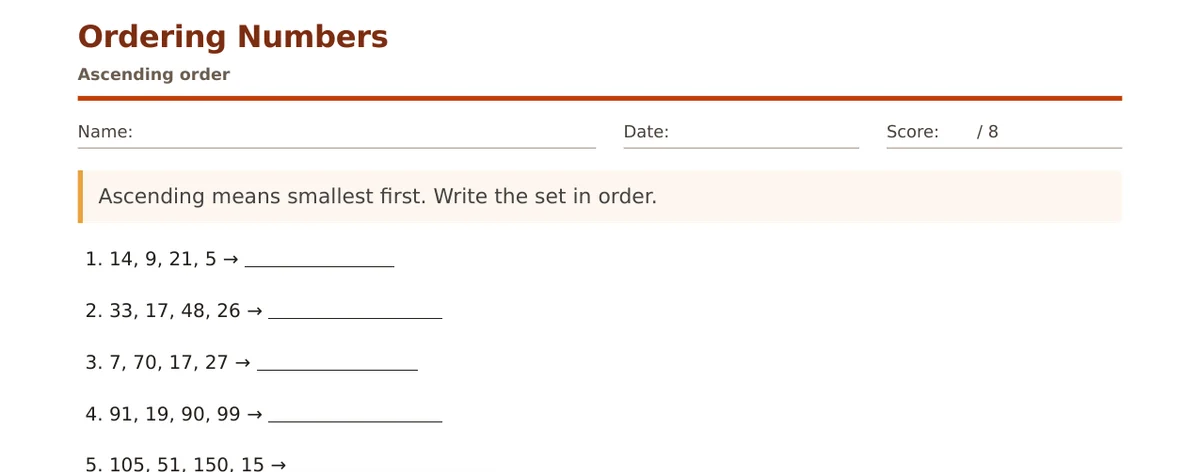
What is on these ordering numbers worksheets
Forty questions over five pages. Ascending order first, then descending, then sequences with a gap, then the missing number in an addition, then the same in a subtraction. An answer key covers every page.
The digits are chosen to catch guessing
Sets like 7, 70, 17, 27 and 111, 11, 101, 110 use the same digits in different positions on purpose. A child comparing by first digit alone gets them wrong.
That is the whole point of the first two pages. Ordering is a place-value skill wearing different clothes, and a set where every number starts with the same digit forces the child to look at the next column.
Ascending and descending
Ascending goes up, descending goes down. The words themselves are the usual stumbling block, not the ordering.
Linking them to something physical helps and sticks: you ascend a staircase going up, and a lift descends to the ground floor. Once the words are secure the task is straightforward, and most errors after that are careless rather than conceptual.
Sequences need the step first
Page three gives gaps in a run of numbers. The move is always to find the step before filling anything: 310, 320, __, 340 is going up in tens, so the answer is 330.
Children who guess from the neighbours alone are right often enough to hide the problem, until a sequence steps by 25 and the guess fails. Asking for the step out loud before the answer catches it early.
Missing numbers are early algebra
7 + ___ = 15 is the same question as 7 + x = 15, written in a way a Grade 2 child can hold. The number sentence is already balanced; the task is to find what makes it true.
The method is subtraction: 15 − 7 = 8. Children who only ever meet addition with the answer on the right find this genuinely hard at first, and it is worth saying plainly that you can work backwards.
Checking is built in
Every answer on pages four and five can be checked by putting it back: 7 + 8 = 15, so 8 is right.
That makes the last two pages self-marking, and the habit matters more than the answers. Children who check their own arithmetic need far less marking later.
How to use them
Ten to fifteen minutes a page. Pages one and two can be done together; pages four and five are better separated by a day or two, because the backwards thinking takes a while to settle.
Why ordering before arithmetic
A child who cannot say whether 101 or 110 is larger cannot sensibly check an addition answer either. Ordering is the skill that makes estimation possible, and estimation is what catches arithmetic errors.
That is the argument for spending time here rather than treating it as filler. It pays back on every later page of calculation.
Common slips
The usual error on the first two pages is ordering by the number of digits alone, which works until two numbers have the same length. The second is reversing ascending and descending, which is a vocabulary problem.
Both are visible in the marking. A child who has every set in perfect reverse order understands ordering completely and has misread the instruction.
For more, our math worksheets cover place value, addition and number sense, and the Grade 2 worksheets guide sets out an order. The National Council of Teachers of Mathematics publishes guidance on early number sense.
Try a few before you print
Four from this pack.
- Put in ascending order: 14, 9, 21, 5
- Put in descending order: 12, 30, 8, 25
- 310, 320, ?, 340
- 7 + ? = 15