Canadian Coins Worksheets — Grade 1 to 3 Money Math Practice
Five pages of Canadian coins worksheets with 40 questions and an answer key.
These Canadian coins worksheets use the coins children actually handle — nickel, dime, quarter, loonie and toonie — over five printable pages of counting, totals and change.
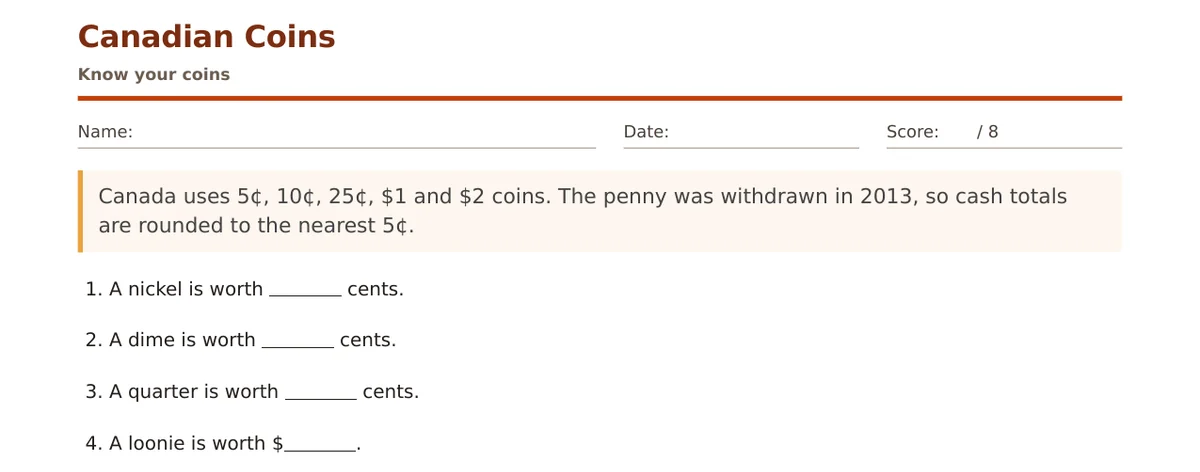
What is on these Canadian coins worksheets
Forty questions over five pages. Page one is coin values and simple exchanges. Page two counts mixed handfuls in cents, page three writes totals in dollars and cents, page four asks for an amount made with the fewest coins, and page five covers change and small shopping totals. An answer key is included.
Canadian coins, not American
Most money worksheets online are American, which means pennies, and a penny is a problem here: Canada withdrew the one-cent coin in 2013. Cash totals round to the nearest five cents.
That single difference changes every answer on a counting sheet. A child working from an American worksheet learns to make 37¢ out of coins that no longer exist in their pocket, which is worse than useless.
These use the five coins in circulation: 5¢, 10¢, 25¢, $1 and $2, with the loonie and toonie named as children name them.
Counting on from the largest
The method worth teaching is to start with the largest coin and count on. For a quarter, two dimes and a nickel: start at 25, count 35, 45, then 50.
Children who start with the smallest coin end up doing the hardest addition last, and children who count every coin as "one" get the number of coins rather than the value. Sorting the pile largest-first before counting fixes both.
The fewest-coins page
Page four asks for an amount made with as few coins as possible, which is a different skill from counting a pile someone handed you.
It is also how change actually works at a till, and it forces the child to think about which coins exist rather than just adding what is in front of them. Making 80¢ needs three quarters and a nickel, not eight dimes.
Change by counting up
Page five does change by counting up rather than subtracting. For a 35¢ sticker paid with a loonie: from 35 to 40, to 50, to 100, giving 65¢.
Counting up keeps the numbers small and matches what a shopkeeper does aloud. Written subtraction with regrouping arrives later and does not need to be the method here.
How to use them
Fifteen minutes a page. Real coins alongside the sheet make a large difference for pages two and four, because the fewest-coins question is much easier to reason about with the coins in hand.
Rounding, and why totals look odd
Because the penny is gone, a cash total of $4.42 is paid as $4.40 and $4.43 is paid as $4.45. Rounding applies to the total, not to each item, and only to cash — a card payment takes the exact amount.
It is worth mentioning once, because a child who has worked out $4.42 correctly and then watches a parent hand over $4.40 will reasonably think they made a mistake.
Reading prices aloud
Children who say "two point seven five" for $2.75 tend to treat the two halves as separate numbers and come unstuck on change. Saying "two dollars and seventy-five cents" keeps the units attached.
It is a small habit and it does most of the work on page five, where the difficulty is nearly always the dollars-and-cents boundary rather than the arithmetic.
For more, our math worksheets cover counting, place value and word problems, and the Grade 2 worksheets guide shows where money fits. The Bank of Canada publishes details of current coins and notes.
Try a few before you print
Four from this pack.
- A quarter is worth how many cents?
- 2 dimes and 1 nickel = ? cents
- 1 loonie and 2 quarters = $?
- A sticker costs 35c. You pay with a loonie. Change in cents?