Homophones Worksheets — Grade 3 and 4 | There, Their, They're and More
Six pages of homophones worksheets for Grade 3 and 4, with forty-eight sentences and an answer key.
These homophones worksheets cover the pairs that cause the most trouble in Grade 3 and 4 — there/their/they’re, your/you’re, its/it’s, to/too/two and hear/here — six printable pages with an answer key.
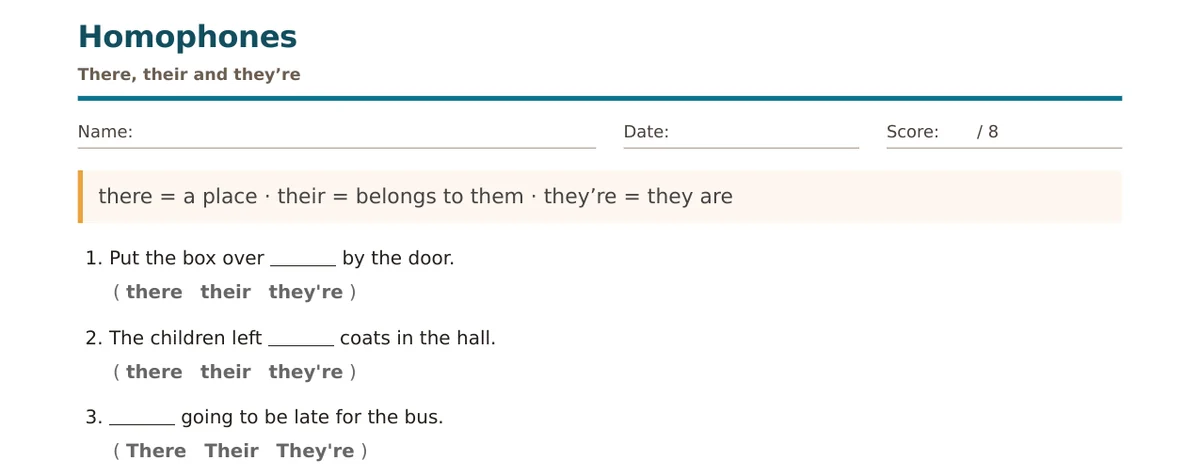
What is in these homophones worksheets
Forty-eight sentences over six pages. Each page takes one set of homophones and does nothing else: there/their/they’re, your/you’re, its/it’s, to/too/two, then hear/here with buy/by/bye, and a mixed review. The choices are printed under every sentence, so this tests meaning rather than spelling recall.
Why these particular words
Homophones sound identical, so the ear is no help at all. A child who writes "their going to be late" has not misheard anything — they have picked the wrong word from a set that sounds the same.
That makes these different from ordinary spelling errors and means they survive long past the age when spelling is otherwise secure. Adults make these mistakes. Practising them one pair at a time, with the meanings visible, is what shifts them.
The apostrophe trap
Its and it’s reverse the rule children have just learnt. Everywhere else an apostrophe signals ownership — the dog’s bowl, Sara’s book — and here it does not. It’s means it is, and its is the one that shows ownership.
The reliable test is substitution: read the sentence with "it is" in place of the word. "The dog wagged it is tail" is wrong, so the answer is its. That test works every time and is worth more than the rule.
The same test works for the others
You’re is you are, and they’re is they are. Expanding the contraction settles every question on pages one, two and three without any need to remember which is which.
"___ going to love this film" expands to "they are going to love this film", which works, so it is they’re. Teaching the substitution test once is more useful than teaching three separate rules, because it is the same test in each case.
To, too and two
Two is the number, and children rarely get that one wrong. The real pair is to and too, where too means also or more than enough and to does everything else.
The extra o is a useful hook: too has more o than it needs, and it means more than enough. Silly, and it sticks.
How to use these
One page at a time, ten minutes each, with a few days between. Doing all six in a sitting turns a meaning exercise into a pattern-spotting one, and the point is the meaning.
The mixed review on page six is the one that matters. Any child can choose correctly when the whole page is about there/their/they’re; choosing correctly when the next sentence might be any pair is the skill that transfers to their own writing.
Marking them
Count the pairs a child gets wrong rather than the sentences. Eight errors spread evenly across six pages is a different problem from eight errors all on the its/it’s page, and only the second needs reteaching.
A child who is right on every single-pair page and wrong on the review has not learnt the words yet — they have learnt what each page is about. That is worth catching, because it looks like success until the writing comes back.
Beyond the worksheet
The test of these is a child’s own writing, not a page where the choices are printed underneath. Reading back one paragraph they wrote and checking only the homophones takes two minutes.
For more, our English worksheets cover spelling, grammar and vocabulary, and the commonly confused words worksheet takes the same idea further for older students. The Reading Rockets spelling pages cover the research.
Try a few before you print
Four sentences from the pack.
- The children left ___ coats in the hall. (there / their / they’re)
- The dog wagged ___ tail. (its / it’s)
- This soup is ___ hot to eat. (to / too / two)
- Tell me when ___ ready to go. (your / you’re)