The Door in the Tree
This creative writing prompt worksheet gives Grade 3 students an illustrated picture prompt — a lit door in the base of an old tree — then walks them through noticing details, planning a story with a problem in it, and drafting it on lined space.
This creative writing prompt worksheet gives Grade 3 students a picture to write from, a planning box to fill in first, and lined space to draft a story with a real problem in it.
What this creative writing prompt worksheet asks for
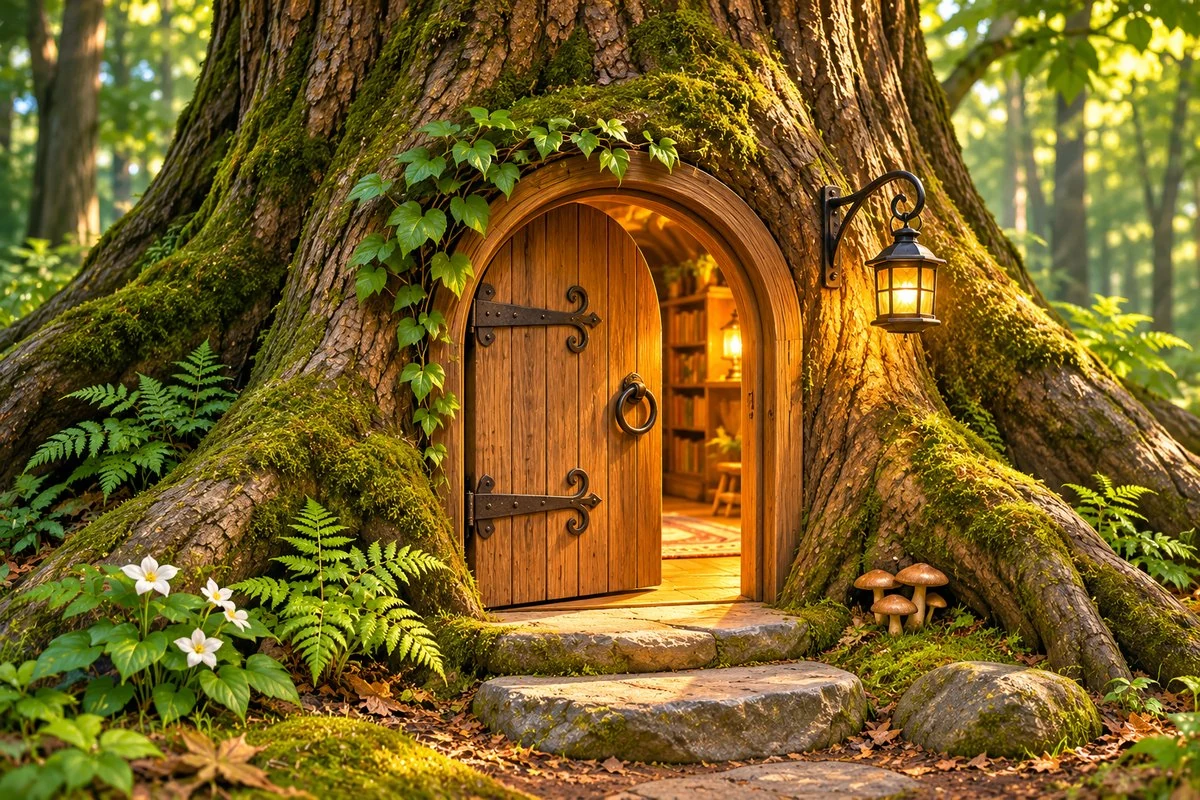
The prompt is a picture: a small wooden door set into the base of an enormous tree, standing open, with a lantern lit beside it and a warm glow coming from somewhere inside. Nothing in the picture explains itself. Who lives there, why the door is open today, and what happens next are all left to the writer.
That is deliberate. A prompt that supplies the story leaves nothing to invent, and a prompt with no anchor at all leaves a child staring at a blank page. A picture full of specific detail and empty of explanation sits between the two.
Why the sheet makes students look before they write
Part A asks four questions about what is actually visible: what is beside the door, what is hanging on the tree, what can be seen through the doorway, what time of day it seems to be. None of these are story questions.
They exist because Grade 3 writers routinely glance at a picture for two seconds and then write a story that could have come from any picture. Ferns, mushrooms, a stone step, a lantern on an iron bracket, a shelf of books just inside — those details are what make a story feel like it belongs to this door and not a generic one.
Planning before drafting
Part B is a five-box plan: who lives behind the door, who finds it, why it is open today, what goes wrong, and how it ends. Students fill it with notes, not sentences.
The fourth box is the one that matters. Most Grade 3 first drafts are a sequence of events with no problem in them — a child walks in, sees things, walks out. Asking for the problem before the drafting starts is far more effective than asking for it afterwards, when the story is already finished in the writer's head.
The plan also gives you something concrete to mark against. If a student planned a problem and then drafted a story without one, that is a specific, fixable gap, and it is much more useful feedback than "add more detail".
Drafting and checking
Part C is sixteen lined rows — enough for a short story, not so many that the page feels like a punishment. Part D is a four-point check the student runs themselves: beginning, middle and end; something goes wrong; three details from the picture; capital letters and end marks.
Self-checking is a skill of its own at this age, and a short fixed list that never changes is easier to internalise than a rubric. The same four points can be used for every story a student writes this year.
How to mark it
Marking notes are on the answer page. The short version: do not correct spelling on a first draft. Children who get a draft back covered in spelling corrections learn to write short sentences using only words they are certain of, which is the exact opposite of what a picture prompt is meant to produce.
Mark structure and use of detail instead, and save the spelling for a piece that is being published. If a draft has no problem in the middle, the one question that fixes it is "what went wrong?" — most students can answer that aloud immediately and then write it in.
Where this fits
This sheet pairs with the descriptive writing worksheet in the same set, which practises detail on its own before it has to carry a plot. For the rest of the set, our English worksheets cover sentence writing, paragraph structure and opinion writing, and the guide to Grade 3 writing explains the order to use them in. The Reading Rockets writing pages cover the research behind planning and drafting.
Check what you noticed
Four quick questions about the picture prompt and how to plan a story.
- What is hanging on the tree beside the door?
- A good story needs something to go ___ in the middle.
- What three parts does a story need?
- Before you write, you should fill in your ___.